
The IP (“International Protection” or sometimes “Ingress Protection”) rating of a load cell is an international standard marking on all electrical devices. It specifies how well that electrical device is protected from “ingress” or intrusion of solid objects, liquids, dust or unintentional contact. This marking has a prefix “IP,” followed by two digits (or an “X” in place of a digit) and possibly the letter “K” after the digits. When choosing a load cell for an application, this rating is one of its more critical specs to know. This article further explains this very important load cell specification. (For a real-world example of where this becomes important, see our Knowledge Base article, Giving a crap: How a Simple Toilet and Load Cells are Tackling Global Ills.)
Key Takeaways
- Ingress Protection Defined: IP ratings (defined by IEC 60529 and ISO 20653) classify the sealing effectiveness of load cell enclosures against solid particles, dust, and water.
- Solid vs. Liquid Digits: The first digit (\(0\text{–}6\)) measures dust and foreign object ingress; the second digit (\(0\text{–}9\text{K}\)) specifies moisture, jet washdown, and submersion resistance.
- IP67 vs. IP68 vs. IP69K Differences: IP67 ratings cover temporary submersion (\(1\text{ m}\) for 30 min), IP68 covers continuous underwater immersion under pressure, and IP69K specifies high-pressure, high-temperature washdown protection.
- Environmental Sensor Lifespan: Selecting an insufficient IP rating for washdown or outdoor environments allows moisture ingress, leading to corrosion of internal strain-gauge components, zero-balance drift, and premature bridge failure.
Understanding the IP Rating Format (IEC 60529 & ISO 20653)
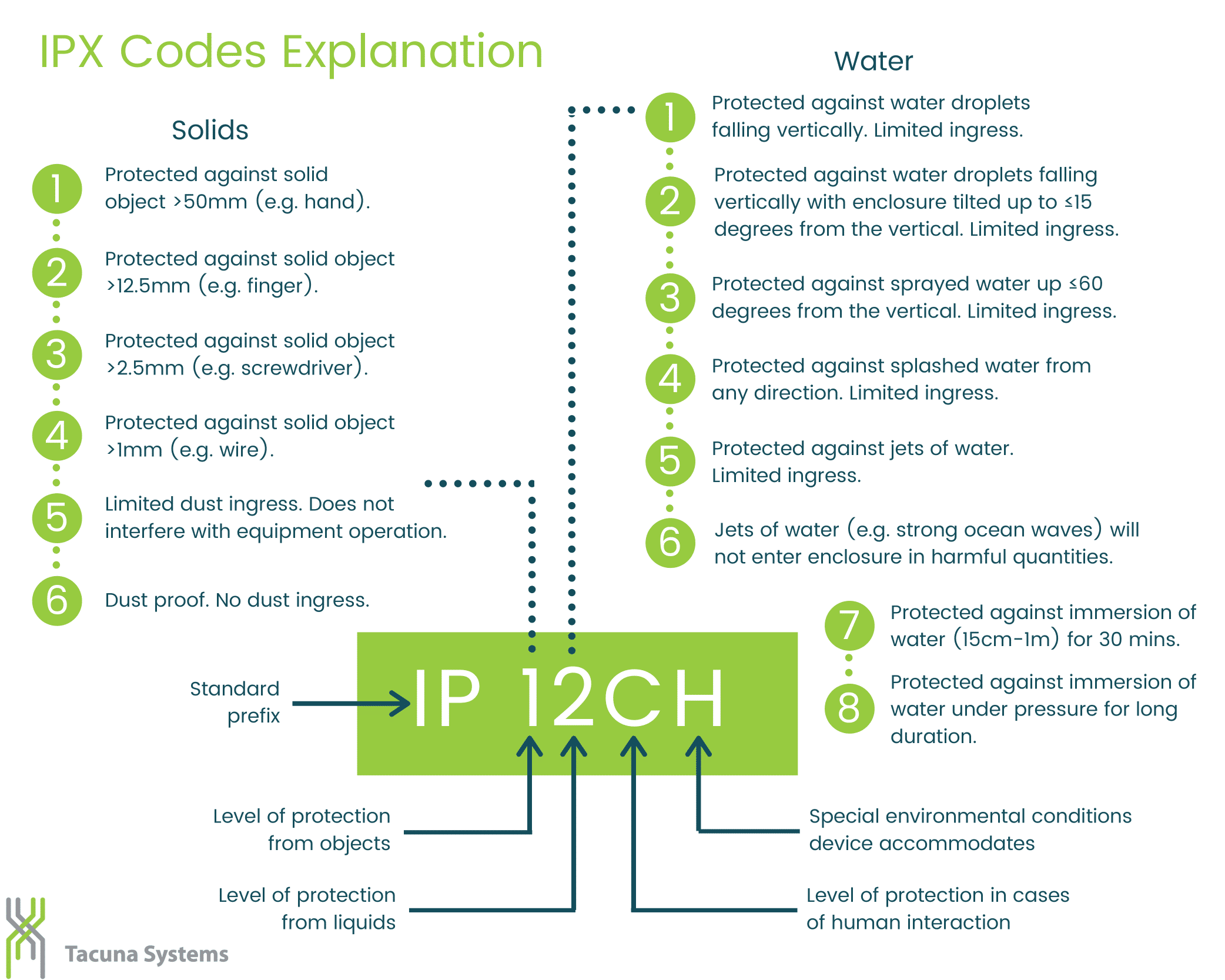
The first two sections below explain the format of the IP rating system of ingress protection. For a quick illustrated summary, see the infographic at the end of this article.
According to IEC 60529, the marking’s first two digits after the “IP” are mandatory. IEC 60529 is the standards document that defines the rating system. The first digit gives the device’s protection from intrusion of solid objects, and has a range of 0-6. The second digit ranges from 0-9K and indicates the level of protection from liquids from various angles, pressure and temperature. An “X” appears in place of either digit when there is no known level of protection for that environmental factor.
The original IEC specification had a highest liquid intrusion rating of 8. However, the German standard DIN 40050-9 introduced the 9K rating for road vehicles, and it was formally incorporated into ISO 20653 and updated in IEC 60529 (Edition 2.2) as standard IP69 for high-pressure, high-temperature washdown environments (e.g., food processing and pharmaceutical facilities). This rating implies the device protects against all lower-described scenarios of water intrusion.
The first two tables below define the levels of IP for each mandatory digit.
First Digit: Protection Against Solid Foreign Objects (0–6)
| Rating Value | Protection Level | Minimum Object Size of No Ingress |
|---|---|---|
| 0 | Non-protected | None |
| 1 | Large solid objects (e.g., hands) | > 50 mm |
| 2 | Medium solid objects (e.g., fingers) | > 12.5 mm |
| 3 | Small solid objects (e.g, fine tools or thick wires) | > 2.5 mm |
| 4 | Granular solid objects (e.g., fine wires) | > 1 mm |
| 5 | Dust-protected (intrusion that doesn’t interfere w/ device operation) | Very fine dust ingress possible |
| 6 | Dustproof | Even the smallest particles cannot enter |
| X | Unrated | No data available |
Second Digit: Protection Against Water & Moisture Ingress (0–9K)
| Rating Value | Protection Level | Water Ingress Test Conditions |
|---|---|---|
| 0 | Not protected | None |
| 1 | Vertically dripping water | Vertically falling drops 1 mm/min for 10 min) |
| 2 | Dripping water (tilted \(15^\circ\)) | Vertically falling drops with enclosure tilted up to \(15^\circ\) |
| 3 | Spraying water | Water sprayed up to \(60^\circ\) from vertical |
| 4 | Splashing water | Water splashed from any direction |
| 5 | Water jets | Water projected from a nozzle (6.3mm) from any direction |
| 6 | Forceful water jets | Powerful water jets (12.5 mm nozzle) from any direction |
| 7 | Temporary immersion | Temporary immersion in water (between 0.15 m and 1 m depth for up to 30 minutes) |
| 8 | Continuous submersion | Immersion under pressure specified by the manufacturer for any duration |
| 9K/9 | High-pressure/temp washdown | High-pressure (80–100 bar), high-temp (\(80^\circ\)C) water jets |
| X | Unrated | No data available |
Engineering Note: IP Rating vs. Sealing Method
An IP rating indicates enclosure testing at room temperature, but does not specify how the seal is achieved. IP65/IP67 load cells often rely on rubber potting or damp-proof organic coatings, which can degrade under thermal cycling or chemical washdown. For harsh food processing or subsea environments, select hermetically sealed (laser-welded stainless steel) load cells rated IP68 or IP69K to prevent fluid migration along cable entries over long-term operation.
Optional Supplemental Letters (Human Touch & Environmental Factors)
In addition to the mandatory numeric characters, the following alpha characters may optionally appear in an IP rating.
The first optional letter specifies protection from ingress where human interaction is possible, as follows:
| Letter | Avoids Ingress Of |
|---|---|
| A | Back of Hand |
| B | Finger |
| C | Tool |
| D | Wire |
The second optional letter specifies the protection of equipment specific to the following environmental conditions:
| Letter | Meaning |
|---|---|
| H | High voltage apparatus |
| M | Motion during water test |
| S | Stationary during water test |
| W | Weather conditions |
IP Rating Selection Guide for Load Cell Applications
The international standard IP rating appears on all load cells, as you will see if you browse Tacuna Systems’ online load cell catalog. All load cells sold by Tacuna Systems fall into the range of IP65 to IP69K.
The graphic below neatly summarizes the marking’s format.