
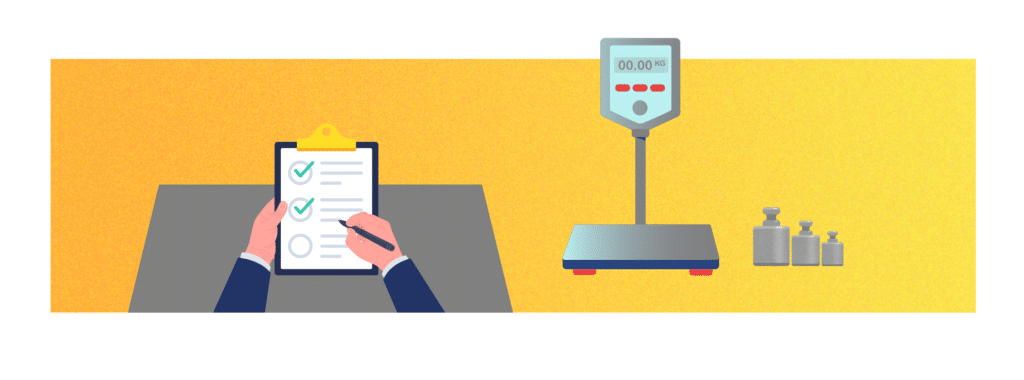
When a business sells goods by weight, a scale reading is more than data. It is the basis of a regulated exchange. “Legal for trade” certification is the verification process that ensures commercial weighing instruments comply with federal and state trade statutes. Beyond legal compliance, this framework protects vendor profit margins and builds customers’ trust in transactions.
In this guide, we’ll address in simple terms common questions we receive regarding “legal-for-trade” definitions, field applications, enforcement, and the historical standards that define modern commercial weighing.
Key Takeaways
- Regulatory Compliance: Legal for trade certification ensures that commercial weighing devices comply with federal and state laws to protect fair commerce.
- NTEP Mandate: In the U.S., NTEP certification is legally mandatory for any scale used for final commercial sales or intermediate production steps that affect transactional billing.
- Two-Step Verification: Full certification requires a sample from a scale model production run to pass design compliance testing, and the individual field unit to pass verification by a government-approved inspector.
- Tolerance Standards: Inspectors evaluate scales against strict acceptance tolerances during initial deployment or after repairs, and wider maintenance tolerances during routine field audits to accommodate normal mechanical wear.
- Regional Jurisdiction: Weights and measures standards are region-specific; Canadian commercial operations must seek certification through Measurement Canada.
- Economies of Calibration: Regular calibration and verification help maintain compliance and avoid costly repairs and penalties for non-compliance.
What is “Legal for Trade” and Why is it Important?
“Legal for trade” is a certification that applies to measuring devices, such as scales, used in commercial transactions where goods are sold by weight, length, or other specific measurements. For example, a legal-for-trade scale ensures that a pound of sugar weighs the same whether purchased in Bangor, Maine, or Albuquerque, New Mexico.
For a measuring device to be “legal for trade” certified, both of these must be true:
- The manufacturer’s model passes specific standards compliance tests for the class of device through an accredited lab, and
- The unit itself complies (and continues to comply throughout its service) with field test tolerances through a government-approved inspector.
We will cover both of these in more detail below.
The whole point of having “legal-for-trade” devices is to make sure the transactions that use them are fair to all involved parties, by law. Since laws require them for commerce, there are fines and other penalties for non-compliance.
Who Decides What is “Fair” in Commercial Trade? (A Brief History)
Trade “fairness” rules originate from various global governing standards bodies and the laws that require adherence to those standards. Historically, localized jurisdictions had regulated trade within their boundaries. This fragmented system was ultimately unified in 1875 by an international treaty creating the International System of Units (SI), signed by 17 nations, including the United States.
By that year, commerce in the United States was quite familiar with regulated trade. Nearly 40 years earlier, in 1836, the United States Congress had established the Office of Weights and Measures (OWM) to ensure fairness in interstate commercial transactions. This was to fulfill its Constitutional mandate in Article 1, Section 8 of the U.S. Constitution, which grants Congress the power to “fix the Standard of Weights and Measures.” Originally part of the Department of the Treasury, the OWM continues to operate today under the National Institute of Standards and Technology (NIST) within the Department of Commerce.
How Does a Device Obtain “Legal for Trade” Certification? (The Two-Step Process)
In the United States, scales obtain “legal for trade” certification upon passing compliance testing conducted through the National Type Evaluation Program (NTEP). This testing, established by the National Conference on Weights and Measures (NCWM), ensures scales meet the accuracy class standards outlined in NIST Handbook 44. The NCWM is a non-profit organization that oversees the administration of NTEP tests. For a more comprehensive guide to Handbook 44 requirements and accuracy classes, see our article, Load Cell Classes: NIST Requirements.
Again, full certification is a two-step process. The first is the scale manufacturer’s responsibility. The onus of the second is with the scale’s commercial user.
Step One: Model Compliance (NTEP Certification)
Rather than exhaustively testing every production unit in a model run, manufacturers submit a working sample for each scale design to the NTEP to prove compliance with NIST requirements. Independent, NTEP-approved laboratories around the US perform these tests. A passing model receives a Certificate of Compliance with a unique number. The NCWM maintains a public database of these certificate numbers that buyers can reference.
Only the final product requires certification. Individual scale components themselves do not require it. Read this FAQ question for more information on this point.
Step Two: Local Field Unit Verification
Before a scale can be used for trade, its owner or user must have the state’s local weights and measures department verify its compliance. During this process, a state-approved inspector:
- confirms the scale model’s certification,
- tests its calibration and performance against the model’s specifications, and
- ensures compliance with all applicable trade laws.
If the scale meets all requirements, the inspector seals the scale’s calibration setting with a sticker as proof of compliance. Since a scale is legal for trade only when this seal is intact, it also deters tampering with the device after certification.
This same verification is legally required at regular intervals, based on how frequently the scale is used. In some states, inspections may also occur randomly. This makes regular calibration essential. Routine scale calibration with known, standard weights can prevent measurement drift and permanent performance degradation over time, which could result in costly fines.
When Does my Scale Legally Require NTEP Certification?
In the United States, a scale requires legal-for-trade certification in these situations:
Final Sale/Transaction
When the scale is used to weigh the final product for price labeling or for setting the price for the customer, it must be NTEP-certified. Examples include:
- A deli counter scale that prints a price label.
- A shipping scale where customer invoicing is by weight.
- A packaging line scale (such as a belt scale) that puts the net weight on the retail product label.
This last example concerns dynamic weighing. That is, the weighing device is part of a moving assembly line. This example has special considerations.
How are Dynamic Weighing Systems Certified “Legal for Trade”?
Dynamic weighing systems, such as food packaging or bottle-filling systems, measure products either while in motion or static for fractions of a second. These weigh systems demand not only high accuracy but fast response times. For this reason, they must pass three accuracy tests unique to these demands:
- They must pass zero stability tests and repeatability tests while the line is operating.
- They must give a readout within expected accuracy tolerances across a range of belt speeds and fill rates, depending on the application.
- Their dynamic measurement must match a reading of the final product on a static scale within allowable tolerances.
Because moving components introduce vibration, exposure to washdown moisture, and other environmental stresses on sensitive weighing electronics, proper scale maintenance is essential to maintaining compliance over time.
Intermediate Production Steps Affecting Commercial Billing
If there is a step in the production or distribution process where the weight is directly used for a commercial transaction, that scale must also be NTEP-certified. For instance, if you sell intermediate quantities to a distributor based on weight before final packaging, the device measuring that weight must have legal-for-trade certification.
When is NTEP Certification Not Necessary for a Scale?
There are three main situations where, legally, scales do not require a Certificate of Compliance:
Internal Quality Control or Inventory Tracking
If a scale is only used internally (e.g., to track inventory, to portion out ingredients within the factory, or to maintain internal process control) and does not directly determine a weight for a sale, NTEP certification is not strictly required. These scales can be in service without a certification, so long as an NTEP-certified device takes the final “legal-for-trade” measurement before a sale or labeling of the net weight.
Research & Development (R&D)
Scales used for product development, lab testing, or other non-commercial activities aren’t typically required to be NTEP-certified.
Non-Commercial Weighing
Any weighing scenario outside of a commercial exchange (e.g., measuring for personal or educational use) does not require “legal-for-trade” certification.
What Happens if My Scale is Noncompliant?
A non-compliant scale will require remediation. When discussing corrective action for non-compliance, it helps to understand the two sets of standards used to evaluate scales: acceptance tolerances and maintenance tolerances.
The Difference Between Acceptance Tolerances and Maintenance Tolerances
To maintain NTEP certification, a scale must adhere to one of two types of field test tolerances, depending on the stage of the scale’s life cycle:
- Acceptance tolerances: These are stricter accuracy standards a scale must meet for its first commercial deployment or after it has undergone corrective maintenance or an overhaul in the case of non-compliance.
- Maintenance tolerances: These looser standards apply to scheduled compliance testing throughout a scale’s lifetime, provided that the scale has not required corrective action. According to NIST Handbook 44, they are typically twice the acceptance tolerances to accommodate normal mechanical wear and tear and environmental drift in a device already in active service over time.
Corrective Action Timelines and Legal Consequences
If a local weights and measures inspector flags a scale as non-compliant during routine verification testing, the owner is typically granted a 30-day window to rectify the issue. This includes situations where only the calibration seal is altered. After repairs, the scale must meet the stricter acceptance tolerances before it can resume commercial use. Regular calibration can help prevent scales from drifting so far out of tolerance that reconditioning becomes necessary.
Failure to comply with these requirements can lead to serious penalties, which vary by state. These may include significant fines, confiscation of equipment, or even business closure in cases of repeated violations.
What About Canadian Legal for Trade?
Canada (as well as the EU) has its own certification process for legal-for-trade scales. Conveniently for our Canadian constituents, our class III platform scales manufactured by ANYLOAD have achieved legal-for-trade certification by Measurement Canada. See this article by ANYLOAD, regarding its latest legal-for-trade certification.
Conclusion
This article covers many of the questions we receive regarding legal-for-trade scale certification and compliance. You can read more about preventing weighing system drifts and other accuracy issues in our guide on force measuring system calibration. If you have further questions or are interested in maintenance calibration, please feel free to contact us.