

In our guide, Measurement Uncertainty in Force Measurement, we explained the rigorous, standards-based measurement uncertainty calculations that determine load cell precision in controlled lab environments. However, for most commercial applications, this rigorous testing is expensive and unnecessary. Instead, simple proof that the load cell performs within specified tolerances (even for “Legal-for-trade“ weighing) is sufficient.
To establish these performance tolerances, standards bodies have created load cell “classes” or levels of precision. These internationally recognized standards bodies have the backing of trade regulation within and among the countries that send representatives to their conferences. When a manufacturer stamps an NTEP badge on a datasheet, they are proving that a certified laboratory has verified the model’s compliance with these strict performance boundaries.
But when you buy an NTEP-certified load cell, what does its accuracy class actually tell you about its real-world measurement output? This guide summarizes the performance parameters defined by NIST Handbook 44 [1] to help you determine the appropriate load cell class for your application.
Key Takeaways
- NIST Handbook 44 Governance: NIST establishes the strict legal frameworks, accuracy classes, and performance standards that govern all commercial weighing equipment and its components in the United States.
- Component vs. System Weight Increments and Divisions: Load cell certification relies on individual verification intervals (\(v\)) and Maximum Permissible Errors (MPE). Separately, real-world field testing evaluates the complete, integrated weighing system for compliance using final scale divisions (\(d\)).
- Component vs. System Certification: Certified components do not earn certification for the scale. Conversely, a certified scale does not necessarily contain certified components. Manufacturers must obtain Certificates of Conformance for each separately.
- Rigorous NTEP Evaluation: The National Type Evaluation Program (NTEP) conducts extensive laboratory testing to issue Certificates of Conformance, ensuring devices pass strict limits on baseline errors like repeatability, creep, and dead load output return.
- Environmental Guardrails: Certified weighing systems must maintain strict accuracy despite varying ambient conditions. NIST specifies temperature and barometric pressure ranges and electrical noise limits where systems must perform within compliance tolerances. When operating outside these conditions, a compliant system must display no reading.
- Continuous Calibration Compliance: Achieving initial type approval is only the first step. Routine field testing and professional calibration ensure that active commercial systems continuously satisfy maintenance tolerances to remain legally certified for trade.
Standards Bodies Governing Load Cells
The National Type Evaluation Program (NTEP) is a testing and certification program administered by the National Conference on Weights and Measures (NCWM). NTEP evaluates weighing devices to ensure they comply with the full set of technical requirements published by the U.S. Department of Commerce’s National Institute of Standards and Technology (NIST) in Handbook 44. Note that this body governs weighing devices for commerce in the United States exclusively, and exists under the authority of Article 1, Section 8 of the U.S. Constitution.
For international standards, our companion article, Load Cell Classes: OIML Requirements, covers the parallel framework set by the International Organization of Legal Metrology (OIML) in Recommendation 60-1 (R60-1) [2]. Together, NIST and OIML define the standards for most load cells worldwide.
Below, we provide a practical summary of Handbook 44 performance parameters and outline how a manufacturer achieves NTEP certification. For the most current, unedited regulations, always refer directly to the full NIST documentation.
Background Concepts in Load Cell Requirements
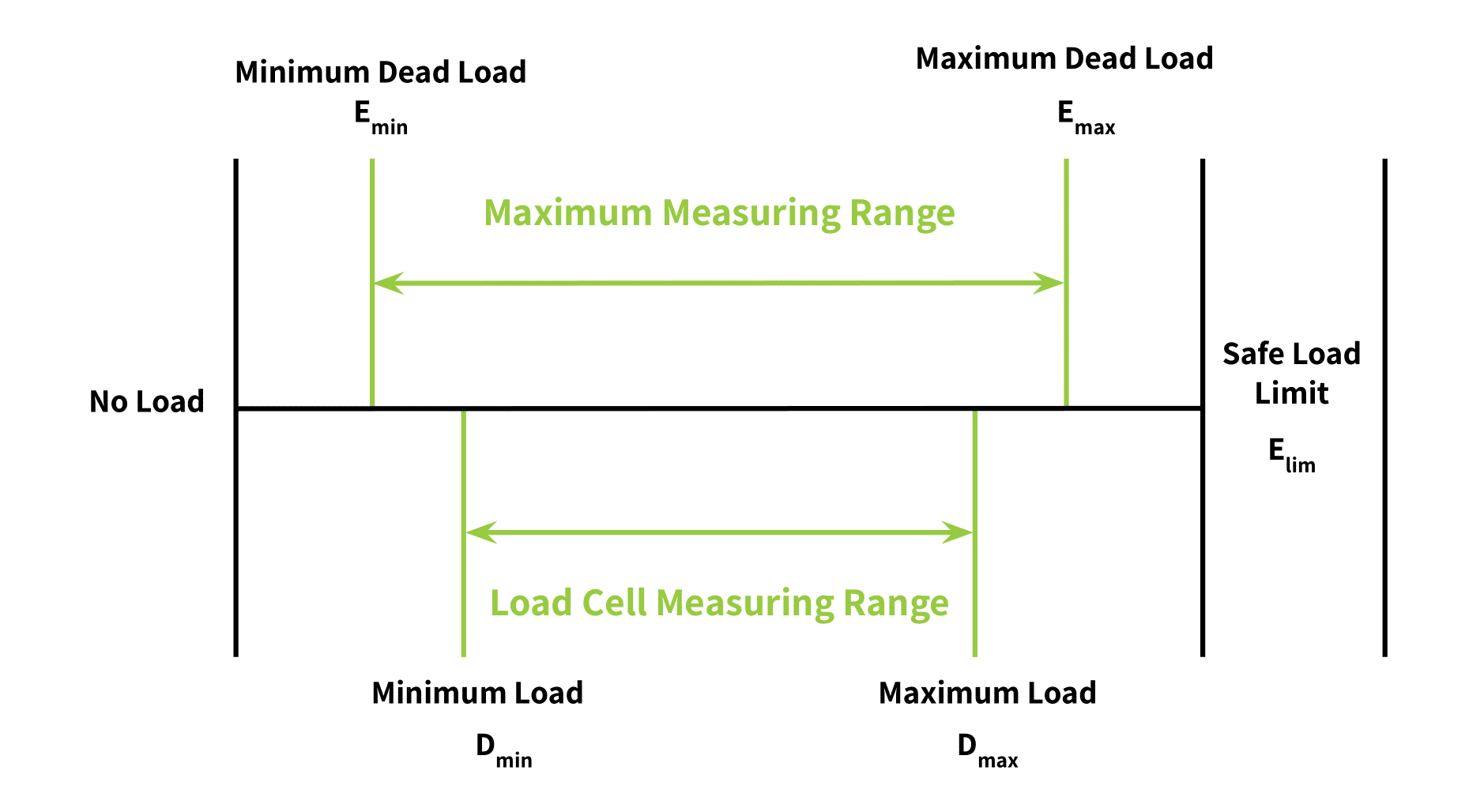
This section reviews basic terminology used in requirements for load cells and measuring systems. Figure 1 depicts them for further clarity.
Load Definitions
The common symbols used to describe loads, and their definitions, appear below.
Term
Symbol
Definition
Minimum Dead Load
\(E_{min}\)
The smallest load (expressed in mass units) that can be applied to a load cell.
Minimum Load of the Measuring Range
\(D_{min}\)
The smallest load (expressed in mass units) applied to the load cell under test, and is required to be within 10% of \(E_{min}\).
Maximum Capacity
\(E_{max}\)
The largest load (expressed in mass units) that can be applied to a load cell, per manufacturer’s specifications. It is usually well below the safe load limit.
Maximum Load of the Measuring Range
\(D_{max}\)
The largest load (expressed in mass units) applied to the load cell under test, and is required to be within 90% of \(E_{max}\)
Safe Load Limit
\(E_{lim}\)
The greatest load (expressed in mass units) that can be applied to the load cell without permanently changing the performance of the load cell.
Measuring Range Definitions
The common expressions for load cell measuring ranges are as follows.
Term
Symbol
Definition
Load Cell Measuring Range
\(D_{max} – D_{min}\)
The range of mass values used for testing.
Maximum Measuring Range
\(E_{max} – E_{min}\)
The maximum range of mass values a load cell can accurately measure.
Verification Interval Definitions
The concept of a verification interval is important to the definition of load cell classes. The common related terms are as follows.
Term
Symbol
Definition
Value of the Scale Division
\(d\)
The smallest unit quantity of weight the measuring device indicator can display. In other words, the scale’s human-perceivable resolution.
Load Cell Verification Interval
\(v\)
The capacity increment of a load cell’s measuring range that is used for testing and certification. This governs each load cell component within the scale.
Minimum Load Cell Verification Interval
\(v_{min}\)
The smallest physical weight increment a load cell can reliably distinguish from background electronic and thermal noise. This is a physical limitation, not a certification limitation.
Verification Scale Interval
\(e\)
The minimum quantity that the scale’s measuring range is divided into for testing and certification. This is the certified resolution for the entire weighing system, not just the load cell component. It must be no more than 10 x \(d\) per NIST Handbook 44 requirements.
Maximum Number of Scale Divisions
\(n_{max}\)
The maximum number of divisions that the maximum measuring range can be divided into for certification. Note \(v\) x \(n_{max}\) = the Maximum Measuring Range.
Other Important Terms
Term
Apportioning Factor
Symbol
\(p_{LC}\)
Definition
A unit-less multiplier applied to a load cell observed error to quantify the portion of that error attributable to the load cell alone.
NIST Load Cell Classes and Their Required Performance
With the common understanding of these key terms, we can define each NIST load cell class and describe the measurement tolerances and precision associated with each.
NIST Classes and Their Commercial Application
NIST assigns five classes to load cells: I, II, III, III L, and IIII based on their applications. (See Table 7a in the Handbook.)
NIST Load Cell Class
Application
I
Precision Laboratory Weighing
II
Laboratory weighing, precious metals and gems, grain test scales
III
All commercial weighing including grain test scales, retail precious metals and semi-precious gem weighing, grain-hopper scales, animal scales, postal scales, laundry scales and on-board vehicle weighing systems up to a 30,000lb capacity
III L
Large capacity commercial scales such as vehicle scales, on-board vehicle weighing systems with a capacity greater than 30,000 lbs, axle load scales, livestock, railway track, crane and hopper scales (other than grain hoppers)
IIII
Weight measurement for highway weight enforcement such as axle load weighers
Scale Divisions (Minimum Resolution) and Full Scale Requirements Per NIST Accuracy Class
For each of these load cell accuracy classes, NIST strictly specifies:
- the number of scale divisions (\(n\)),
- the value of the scale division (\(d\)), and
- the value of the verification scale interval (\(e\)).
The table below summarizes these generically, based on Table 3 from [1]. Note that NIST enforces additional, application-specific values for these parameters depending on the exact commercial weighing environment. Refer to Handbook 44 for these exceptions. (Also, see our article, What is the Lowest Weight a Load Cell Can Measure? for a more in-depth explanation of these concepts.)
Table 1: Parameters for Accuracy Classes
| Class | Value of Verification Scale Division (e) | Number of Scale Divisions (n) | |
|---|---|---|---|
| Minimum | Maximum | ||
| SI Units | |||
| I | ≥ 1 mg | 50,000 | — |
| II | 1 to 50 mg, inclusive | 100 | 100,000 |
| ≥ 100 mg | 5,000 | 100,000 | |
| III | 0.1 to 2 g, inclusive | 100 | 10,000 |
| ≥ 5 g | 500 | 10,000 | |
| III L | ≥ 2 kg | 2,000 | 10,000 |
| IIII | ≥ 5 g | 100 | 1,200 |
| U.S. Customary Units | |||
| III | 0.0002 lb to 0.005 lb, inclusive | 100 | 10,000 |
| 0.005 oz to 0.125 oz, inclusive | 100 | 10,000 | |
| ≥ 0.01 lb | 500 | 10,000 | |
| ≥ 0.25 oz | 500 | 10,000 | |
| III L | ≥ 5 lb | 2,000 | 10,000 |
| IIII | > 0.01 lb | 100 | 1,200 |
| > 0.25 oz | 100 | 1,200 | |
Maximum Permissible Error Per Load Cell Class
Unlike the OIML framework, NIST provides its primary load cell error table specifically under time-dependence guidelines to quantify permissible errors due to creep and creep recovery.
Table 2 (from Table T.N.4.6 of [1]) outlines these Maximum Permissible Errors (MPE) per load cell class for type evaluation testing only. In the NIST lexicon, “type evaluation” refers to the rigorous, independent laboratory testing a load cell model must undergo to achieve its initial NTEP certification.
NTEP Compliance Note: Type evaluation tolerances apply strictly to the manufacturer’s prototype testing phase. Once a scale is deployed in a real-world commercial setting, it is subject to additional, periodic inspections using maintenance tolerances to ensure it remains legal-for-trade.
Table 2: MPE During Type Evaluation For Each Load Cell Class
| Class | MPE in Load Cell Verification Divisions (v) = pLC × Basic Tolerance | ||
|---|---|---|---|
| pLC × 0.5 v | pLC × 1.0 v | pLC × 1.5 v | |
| I | 0 – 50,000 v | 50,001 – 200,000 v | 200,001 v + |
| II | 0 – 5,000 v | 5,001 – 20,000 v | 20,001 v + |
| III | 0 – 500 v | 501 – 2,000 v | 2,001 v + |
| IIII | 0 – 50 v | 51 – 200 v | 201 v + |
| III L | 0 – 500 v | 501 – 1,000 v | Add 0.5 v to basic tolerance for each additional 500 v (Max 10,000 v) |
In the table, \(v\) represents the load cell verification interval (as we established before), and \(p_{LC}\) is the apportionment factor (the proportion of error attributable to the load cell alone). NIST gives specific apportionment factor values per application as follows:
- \(p_{LC} = 0.7\) for load cells of any class other than III L marked “S” (intended for single load cell applications).
- \(p_{LC} = 1\) for load cells of any class other than III L marked “M” (intended for multiple load cell applications).
- \(p_{LC} = 0.5\) for all Class III L load cells, whether marked M or S.
NIST allows a higher permissible error for individual load cells in multi-cell applications since they bear only a fraction of the total load. This means that they each contribute less error to the system than they would in a solo application. Also, statistically, their random errors tend to cancel each other when their output signals combine at the junction box.
Tolerance Types and Values per Accuracy Class
Beyond the MPE for the component load cells, NIST sets specific, total-weigh-system performance tolerances for each accuracy class. These limits change proportionally with the value of the scale division, \(d\).
NIST splits these tolerances into two distinct categories:
Acceptance Tolerances
Acceptance tolerances isolate baseline device errors (such as hysteresis) under strictly controlled environments. These narrow testing conditions require a specified temperature range, stable barometric pressure, and a consistent power supply.
These tight limits apply for the following scenarios:
- When performing load cell type evaluation,
- Before deploying a weighing device for commercial use for the first time,
- Within 30 days of corrective service for any NTEP non-compliance, or
- Within 30 days of an overhaul or reconditioning of the system.
Maintenance Tolerances
Maintenance tolerances apply to equipment in use or field testing. Systems must stay within these bounds regardless of the ambient conditions. Because these conditions can vary widely, maintenance tolerances are generally twice the limits for acceptance tolerances.
Table 3 outlines the basic maintenance tolerance requirements per accuracy class (adapted from NIST Handbook 44, Table 6 [1]). Because NIST enforces additional requirements for unique applications (such as postal scales or axle-load weighers), device owners should consult Handbook 44 for their specific application rules.
This table shows that allowable weigh-system errors scale up in tiers as the load increases. For example, if you have a Class III scale with a scale division \(d\) of 1 lb, the system allows a maximum maintenance error of just 1 lb for any test load between 0 and 500 lbs. If you increase the test load to between 501 and 2,000 lbs, the allowable error budget steps up to 2 lbs.
Table 3: Maintenance Tolerances Per Accuracy Class
| Class | Tolerance in Scale Divisions (d) | |||
|---|---|---|---|---|
| 1 d | 2 d | 3 d | 5 d | |
| I | 0 – 50,000 | 50,001 – 200,000 | 200,001 + | — |
| II | 0 – 5,000 | 5,001 – 20,000 | 20,001 + | — |
| III | 0 – 500 | 501 – 2,000 | 2,001 – 4,000 | 4,001 + |
| IIII | 0 – 50 | 51 – 200 | 201 – 400 | 401 + |
| III L | 0 – 500 | 501 – 1,000 | Add 1 d for each additional 500 d or fraction thereof | |
Individual Error Parameters and Ambient Limits per Accuracy Class
The total scale error described by Table 3 combines several distinct mechanical and environmental factors. NIST isolates these parameters during testing to further prove that the overall system can successfully maintain these tolerances in real-world environments.
Limits on Repeatability Error per Scale Accuracy Class
Repeatability measures a weighing system’s ability to display the same weight value for repeated weighings of the same load.
NIST does not specify how many times a technician must weigh a load within a certain timeframe. Instead, Handbook 44 simply mandates a hard ceiling: successive weighings of the same load under identical conditions must agree within the maintenance tolerances shown in Table 3. If a Class III floor scale allows a 2 lb tolerance for a specific load, the display cannot fluctuate by more than 2 lbs between repeated tests.
Limits on Creep Error per Load Cell Accuracy Class
Creep occurs when a load cell stays under a heavy weight for an extended period, causing its digital output signal to slowly drift over time. If a sensor creeps too much, a static pallet or truck will appear to gain or lose weight the longer it sits on the scale.
NIST evaluates creep during laboratory type testing using the sensor’s maximum recommended load (\(D_{max}\)). Like OIML R60, this load must fall between 90% and 100% of its absolute physical capacity (\(E_{max}\)). Handbook 44 enforces two strict time-dependent limits:
- The 30-Minute Test: When a technician loads a cell to \(D_{max}\) for 30 minutes, the total change between the initial reading and any subsequent reading during the test cannot exceed the absolute Maximum Permissible Error (\(|MPE|\)) calculated from Table 2.
- The 20-to-30 Minute Window: To catch late-stage signal drift, the final reading at the 30-minute mark cannot differ from the reading taken at the 20-minute mark by more than 0.15 times the \(|MPE|\).
Limits on Dead Load Output Return Per Load Cell Class
Dead Load Output Return measures how perfectly a load cell returns to its baseline zero balance after a heavy load is removed. A quality load cell spring element will return to its original shape without “memory” of the large load, rather than show a false-positive reading.
Technicians record the zero-load reading (\(D_{min}\)) immediately before and immediately after running the 30-minute creep test described above. To pass certification, the post-test zero reading cannot differ from the pre-test baseline by more than the following component-level limits:
Class
Recovery Value
II and IIII
\(0.5v\)
III where \(n \leq 4000\)
\(0.5v\)
III where \(n > 4000\)
\(0.83v\)
III L
\(2.5v\)
Temperature Boundaries Where Error Tolerances Must Be Met
NIST, like OIML, has strict performance requirements for ambient temperatures as real-world applications demand accuracy for widely variable conditions. By default, NIST performance tolerances and MPE limits apply across a standard temperature range of -10°C to 40°C (14°F to 104°F) for all accuracy classes.
If a manufacturer designs a weighing system for extreme environments outside this standard window, the customized operating temperature range must span at least the following minimums per class:
Accuracy Class
Class I
Class II
Class III, III L, IIII
Minimum Temperature Span
\(5^{\circ}\)C (\(9^{\circ}\)F)
\(15^{\circ}\)C (\(27^{\circ}\)F)
\(30^{\circ}\)C (\(54^{\circ}\)F)
For Class III devices and higher, NIST requires a built-in safety cutoff. If the ambient air temperature drops below or rises above the scale’s certified operating range, the display screen must automatically shut off or indicate no weight reading. Normal operation can only resume once the hardware’s internal temperature returns to its certified range.
Further Temperature Boundaries: Zero Balance Variation Per Temperature Change
Even when a scale bears no load, extreme temperature swings can cause the internal electronics to drift, resulting in a false weight reading. NIST restricts this component-level drift.
The empty zero balance value for a compliant load cell cannot vary by more than:
- 3 load cell verification intervals (\(3v\)) per 5°C (9°F) temperature change for Class III L sensors.
- 1 load cell verification interval (\(1v\)) per 5°C (9°F) temperature change for all other accuracy classes.
Barometric Pressure Boundaries Where Error Tolerances Apply
Likewise, barometric pressure changes in changing weather affect accuracy.
For all load cell classes except for Class I, the zero indication variance must be one scale division or less for a change in barometric pressure of 1 kPa over the total barometric pressure range of 95 kPa to 105 kPa (28 in to 31 in of Hg).
Scale Functions when Other Environmental Factors Affect Accuracy
NIST Handbook 44 (Section 2) also outlines strict operational cutoffs for radio disturbances, power interruptions, and low power. Outside these limits, the scale must automatically shut off or indicate no reading.
NTEP Certificates of Compliance
The previous sections establish the NIST Handbook 44 requirements for scale and load cell tolerances per accuracy class. This section describes the process manufacturers must follow to prove compliance. As we mentioned before, the National Type Evaluation Program (NTEP) oversees this process. To earn an NTEP certificate, a device must pass rigorous, sometimes months-long evaluations at an authorized laboratory to prove it meets all Handbook 44 requirements.
Typically, a manufacturer submits a sample unit to the lab before selling that model for use in commercial trade, law enforcement, or regulatory data collection. If a device fails a test, the manufacturer must fix the issues and resubmit the unit within 90 days. If a specific design fails three consecutive testing cycles, NTEP will reject the application entirely until the manufacturer provides documented proof of a complete design overhaul.
Compliance Test Equipment Accuracy
To ensure NTEP laboratory and field evaluations are perfectly accurate, the calibration weights and test instruments themselves must meet strict error limits. NIST requires that the maximum error of any test equipment used during certification cannot exceed either of these limits:
- 1/3 of the allowed tolerance for the component load cell, or
- 70% of the tolerance of the complete end-to-end weighing system.
Required Labeling for Compliant Devices
Once a manufacturer obtains a certificate of compliance, NIST requires that they display the following regulatory markings on the device:
- Manufacturer’s identification
- Model number
- Serial number
- Load cell accuracy class
- Nominal capacity and value of the scale division (\(d\))
- Any special operating temperature range, if outside the \(14^{\circ} – 104^{\circ}\)F default
- Whether rated for single or multiple load cell applications
Active vs Inactive NTEP Compliance Status
NTEP categorizes Certificates of Conformance into two distinct operational statuses:
- Active Status: This means the manufacturer actively maintains the certificate, pays the annual fees, and conforms to current production audits. Any load cell built, sold, or deployed under an active certificate carries full legal-for-trade status.
- Inactive Status: This occurs when a manufacturer allows an older certificate to expire or stops paying the maintenance fees—often because they discontinued that specific model line. However, devices already sitting in an equipment distributor’s inventory or currently operating out in the field remain perfectly legal to buy, sell, or use commercially (in other words, legal-for-trade), provided:
- The manufacturer built them while the certificate was still active, and
- The device continues to meet all maintenance tolerances outlined in Table 3.
Whole System vs. Component Compliance
A very common point of confusion in industrial metrology is the difference between certifying an individual scale component versus certifying the complete scale. NTEP evaluates components and complete systems as entirely separate entities:
- Component Certification: Testing laboratories frequently evaluate individual parts, such as a specific load cell model. However, assembling a scale entirely from NTEP-certified parts does not automatically deem the finished scale compliant. The complete, fully integrated system must pass its own comprehensive evaluation.
- System Certification: Conversely, if a manufacturer certifies a complete, fully integrated weighing system, that system’s certificate does not grant individual, standalone certifications to its internal load cells. Also, if a technician replaces a certified system’s original load cells with a different model during field service, the entire weighing system is no longer NTEP-compliant. The unit can regain certification only when a certified agency inspects and recertifies the new configuration.
Ultimately, the component manufacturer is responsible for compliance testing of its load cell models. Likewise, scale manufacturers are responsible for obtaining the final Certificate of Conformance for their complete weighing systems. See our article on legal for trade scales for more information on whole-system compliance.
Conclusion
Understanding NIST performance requirements and tolerances ensures that your commercial weighing systems remain legally compliant and structurally accurate. A certified load cell reliably meets its strict accuracy class standards when backed by a routine, professional calibration schedule. If a system fails a field inspection or drifts outside its allowed maintenance tolerances, operators must remove the device from service immediately for repair or replacement.
As established throughout this guide, a load cell’s accuracy class directly dictates its resolution intervals (\(v\)), which ultimately define the physical measurement limits of the final scale system (\(d\)). For a deeper technical dive into the physical resolution limits of these sensors, explore our comprehensive article, What Is the Lowest Weight a Load Cell Can Measure?
If you have any questions about your hardware or notice your load cells behaving outside of their official specifications, contact the engineering team at Tacuna Systems.
References
[1]
NIST Handbook 44, Specifications, Tolerances, and Other Technical Requirements for Weighing and Measuring Devices, as adopted by the 104th National Conference on Weights and Measures, 2019, National Institute of Standards and Technology, US Department of Commerce (latest version, 2025 as adopted by the 109th National Conference on Weights and Measures)
[2]
OIML R 60-1, Metrological regulation for load cells Part 1: Metrological and technical requirements, Organisation Internationale de Métrologie Légale, Edition 2017 (latest version 22 November 2021)
[3]
R 60 OIML-CS rev.2 Additional requirements from the United States Accuracy class III L, Organisation Internationale de Métrologie Légale, January 2018 (latest version 22 November 2021)