
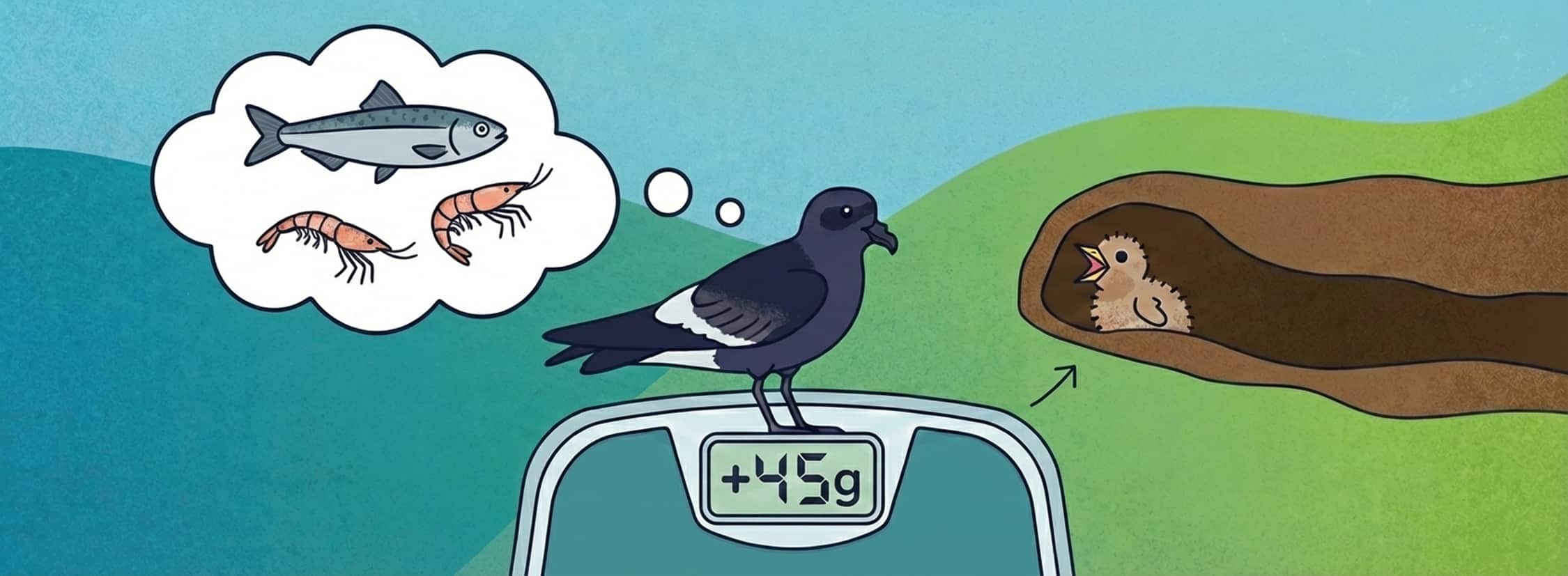
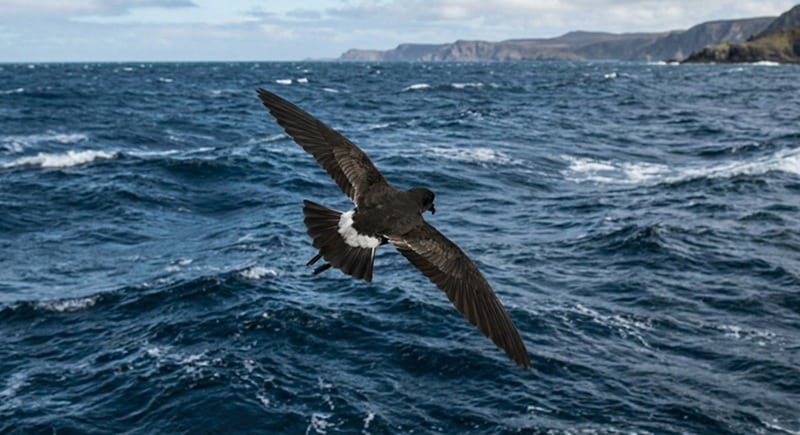
Every parent faces the challenge of getting enough nutrition into their growing child. Now, imagine having to meet that challenge by traveling hundreds of miles between meals to grab some grub. That’s exactly the fate of the Leach’s storm petrel, a small seabird that is big on endurance. Leaving their single chick hidden deep in an earthen burrow for days at a time, they will travel hundreds of miles over the open ocean to forage for both their growing offspring and themselves.
This avian quest piqued the curiosity of a group of researchers led by Robert Mauck of Kenyan College. How do these parents ration their haul after such a long flight? Do they forage strategically, adjusting the amount of food they gather based on their chick’s age? Or do they simply “wing it,” collecting as much as they can and deciding what to share only upon arriving at the nest? Answering these would require some ingenuity, some load cell technology, and Tacuna Systems’s custom PCB service.
Key Takeaways
- A group of researchers studying the nesting habits of Leach’s storm petrels needed a way to weigh the parent birds, rather than the chicks, to determine if they foraged more during their long oceanic flights, as their offspring grew.
- Using a burrow lining device equipped with a load cell, ADC, and Arduino microcontroller, this group was able to accomplish this for the first time. They called this device the “Burrow Scale Monitor” or BSM.
- Tacuna Systems created a custom PCB (Arduino shield) for the BSM system to transform the prototype into a field-ready research instrument capable of operating in the challenging conditions of a seabird colony. Beyond this study, the device opens the door for further research on adult petrel behavior.
- Collected data showed that parents do not adjust their foraging based on chick age but rather increase the proportion of food delivered as chicks grow.
- This study provides another example of how the innovative use of load measurement technology can advance scientific discovery.
The Challenge: Why Weighing a Storm-Petrel is So Hard
For decades, seabird researchers had estimated nutritional quantities delivered by this species by weighing the chicks once a day. The change in each chick’s mass was used as a proxy for how much food it had received. While useful, this method could not address the question of how much food the parent arrived with after its foraging trip. In other words, did the parents of this species account for their own caloric needs when foraging, or mainly the needs of their offspring?
Without knowing the parent’s arrival weight, it is impossible to distinguish between a parent that had a successful hunt with plenty to go around versus one that had less success and gave away most of the food it found. Yet, weighing the arriving parents had historically presented its challenges due to their nocturnal feeding behavior. That is, finding and manually weighing parent birds in pitch black had proven elusive. Mauck’s team decided to try a novel approach.
The Solution: Engineering the “Burrow Scale Monitor“
To overcome this measurement hurdle, the research team developed an innovative device called the Burrow Scale Monitor (BSM). This compact, load cell-based weighing system is designed to fit within narrow burrow entrances. As a storm-petrel walks in or out, the embedded scale records its mass.
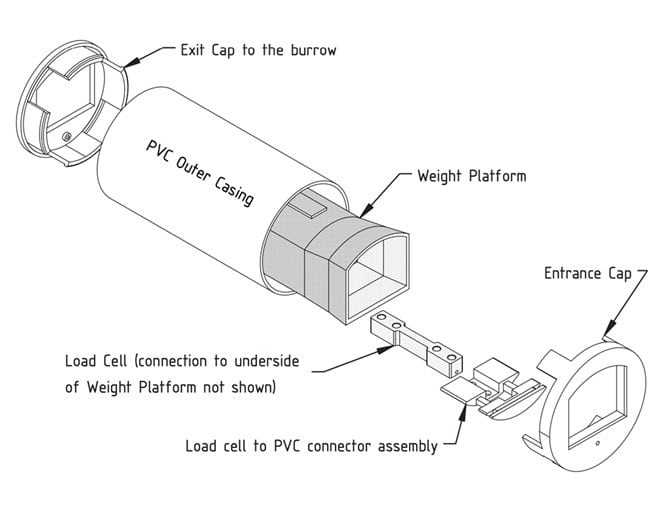
Figure 1 shows an exploded view of the tunnel within a tunnel of the BSM. The inner tunnel forms the Weight Platform, which is suspended within the outer tunnel (PVC Outer Casing) via the Load Cell. One end of the Load Cell is attached to the bottom of the Weight Platform with #4 machine screws. The other end of the Load cell is connected to PVC outer casing through the Connector assembly with #4 machine screws. The connector assembly has 2 parts (Plug and WireClamp). Both ends of the Outer Casing are capped to prevent dirt and debris from entering the tunnel assembly. --Source: (2)
The Burrow Scale Electronics
The BSM’s mechanical design balances accuracy with the physical constraints of the burrow. A single-point load cell is suspended inside a 3D-printed inner tunnel that serves as the scale’s platform. (See Figure 1.) This inner tunnel is mounted within a rigid outer PVC sleeve that stabilizes the device in the burrow. This design minimizes sensitivity to how the bird positions itself as it passes through. This outer tunnel, equipped with apertured caps on either end, also protects the electronics from moisture, soil, and disturbances.
The load cell connects to an Arduino-based data acquisition system (DAQ) housed in a weatherproof enclosure. Within this enclosure are the microcontroller, load cell amplifier, data logger, scale display, and battery. The complete design allows the system to operate unattended for long periods in field conditions.
From Prototype to Field Resilience
The researchers’ initial prototype used an Arduino controller with a standard HX711 amplifier to process the load cell signal. While sufficient for early testing, the system lacked the precision and long-term stability required for extended field deployment. To meet those demands, the team selected the AD7193, a high-resolution, low-noise, 24-bit analog-to-digital converter. These upgrades offer improved filtering, noise performance, and measurement stability.
“Tacuna’s work really helped us. I’d built a prototype with lots of moving parts and wiring. It worked great except when the environmental conditions and physical stresses of our work made the connections unreliable. When Tacuna consolidated all of it into one shield, Voila! We’ve never had an issue since.”
–Robert Mauck
At that point, the team sought out Tacuna Systems‘s custom PCB service to integrate the AD7193 and a 16×2 LCD display into the existing Arduino platform with minimal wiring and no soldered connections. Tacuna Systems delivered a custom Arduino shield that combined these components into a single, robust add-on module. According to Mauck, “Tacuna’s work really helped us. I’d built a prototype with lots of moving parts and wiring. It worked great except when the environmental conditions and physical stresses of our work made the connections unreliable. When Tacuna consolidated all of it into one shield, Voila! We’ve never had an issue since.” That is, the new shield transformed the prototype into a field-ready scientific instrument capable of operating in the seabird colony’s harsh environment.
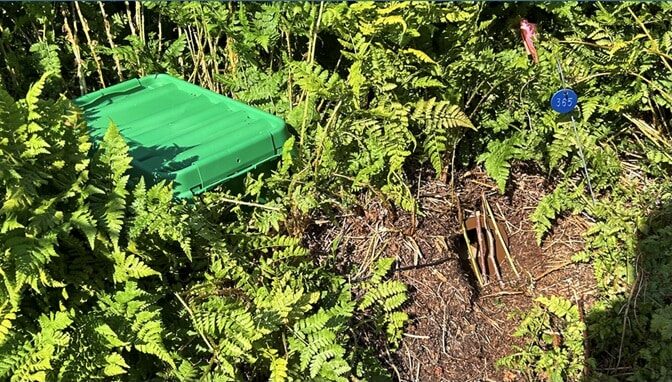
Figure 2 shows the BSM field installation. Inside the green waterproof box are the Arduino and the battery. The black wire, visible across the mud left of the burrow entrance, runs from the Arduino to the BSM tunnel within a tunnel. The sticks covering the burrow entrance allow the researcher to know if a petrel has entered; disturbed twigs indicate a potential feeding. --Source: (2)
Burrow Selection
Before full deployment, the team carefully selected burrows to minimize disturbance and measurement artifacts. Within these, they installed non-instrumented “sham” tunnels in advance so birds could habituate to the structure. Out of this group, the researchers chose only actively incubated burrows with relatively level entrances. The latter minimizes the need to compensate for non-axial loading.
The Discovery: Leach’s Storm Petrels “Wing It”
With the fully tested and calibrated, field-quality scale, the researchers could finally test their two competing hypotheses about storm-petrel parenting strategy:
- Hypothesis 1 (Plan Ahead): Petrel parents adjust their foraging strategy at sea to match the chick’s age. In this scenario, they return with progressively larger meals as the chick grows. This would mean their arrival weight would increase over time.
- Hypothesis 2 (Wing It): Parents forage without regard to chick age. This means the parent adjusts how much food they deliver once they return to the nest. In this scenario, their arrival weight would remain consistent, but the proportion of their body mass given as food would increase as the chick got older.
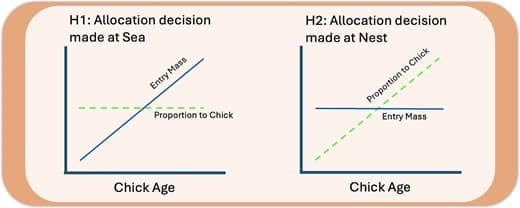
Figure 3: Predictions from competing hypotheses for parental food delivery relative to chick age. If parents adjust entry mass (solid line) to chick age (Hypothesis 1), then entry mass will increase with chick age and the proportion of entry mass delivered (dashed line) will not. The opposite is true if parents forage without regard to chick age and adjust the proportion of entry mass delivered to chick age upon return from foraging (Hypothesis 2). --Source: (1)
The BSM measurement system data clearly supported the second explanation. Adult arrival weight remained largely unchanged over time, while the proportion of mass transferred to the chick increased as the chick matured. In other words, parents did not bring back more food; instead, they provided progressively more as the chick and its appetite grew.
This finding helped the team understand how long-lived seabirds balance their own survival with the demands of raising offspring. By maintaining consistent foraging behavior, storm petrels protect their long-term energy reserves while still meeting the needs of their growing chicks.
Looking ahead, this device has opened the door for further studies of parent petrel behavior that involve weight. And with that, we have another example of a scientific discovery made possible by innovative load cell use and Tacuna Systems’s custom PCB work!
Conclusion: From a Small Burrow to Big Ideas
This project followed a classic arc of scientific discovery: it began with a compelling biological question, encountered a technical challenge, and moved forward through a thoughtful combination of scientific insight, collaboration, and custom engineering. The technology behind the Burrow Scale Monitor shows how high-precision measurement tools and ingenuity can unlock data that was previously out of reach. With the right measurement approach, researchers can gain deeper insight into survival in the natural world and the systems that shape it.
At Tacuna Systems, we enjoy the wide range of measurement problems our customers bring us. Developing custom solutions for unique challenges like this, and supporting the many creative ways load cells are put to work, is what we are here for. What challenge could we help your team tackle next?