
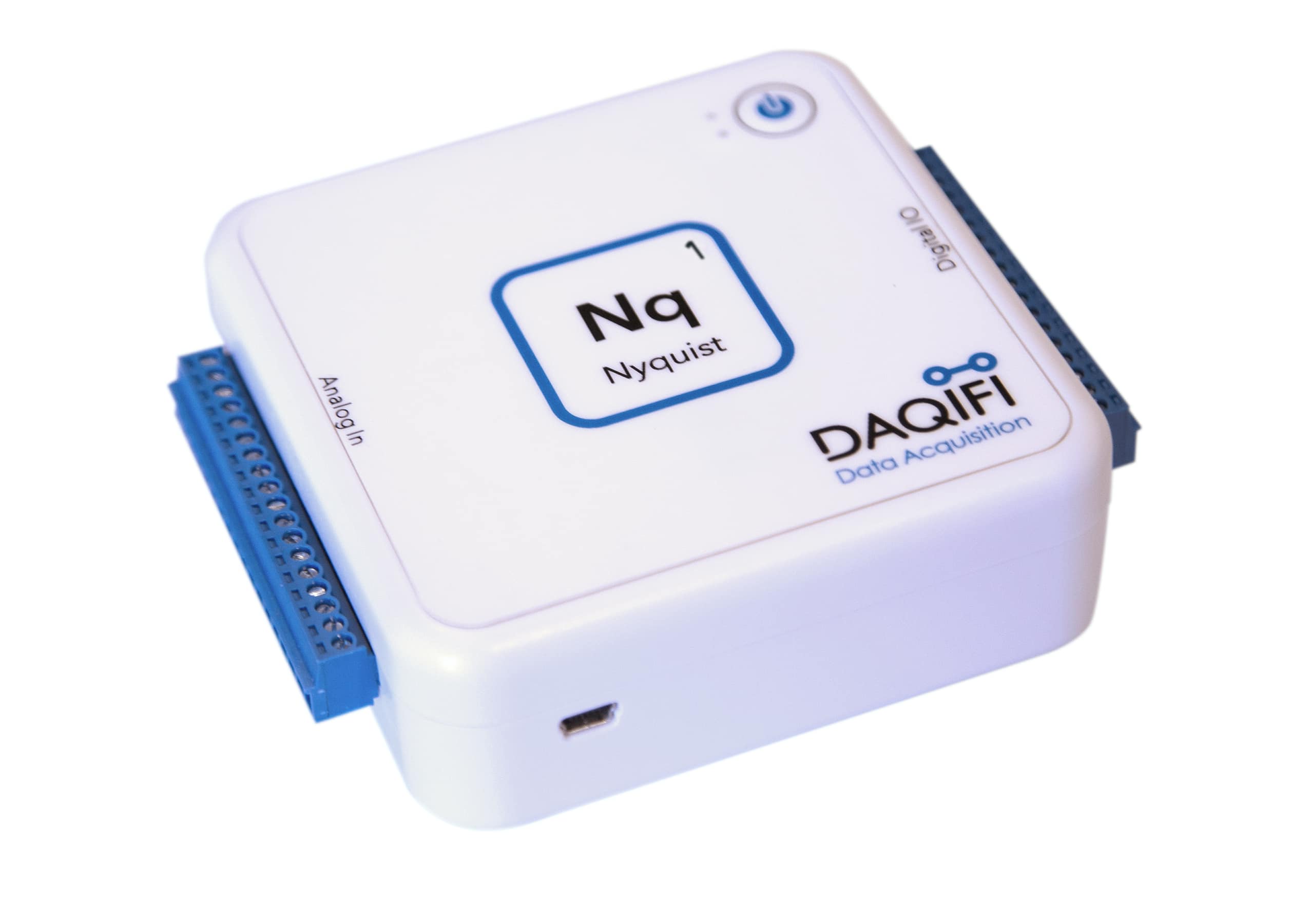
DAQiFi Nyquist 1 Wireless Data Acquisition System
The DAQiFi Nyquist 1 is a portable, battery-powered data acquisition system with 16 channels of 12-bit analog input, 16 configurable digital I/O, WiFi, USB, and on-device microSD logging. Because it carries its own battery and its own radio, it records and streams measurements wherever the sensor is — no PC and no mains power at the measurement point.
Its 0–5V single-ended analog inputs accept the output of the Tacuna Systems EMBSGB200 amplifier directly, which turns any strain gauge or load cell into a mobile measurement that logs to an SD card or streams over WiFi.
The Nyquist 1 is open-source hardware, firmware, and software, and it speaks standard SCPI over USB or WiFi — so it drops into LabVIEW, Python, .NET, Node-RED, or any test framework that can open a socket or a serial port.
$199.00
| Quantity | Price |
|---|---|
| 1 - 9 | $199.00 |
| 10 - 24 | $189.05 |
| 25 - 49 | $183.08 |
| 50 - 99 | $177.11 |
| 100 + | $169.15 |
DAQiFi Nyquist 1 Wireless Data Acquisition System
The DAQiFi Nyquist 1 is a portable data acquisition system built for measurements that have to happen away from a bench. It carries a 4000mAh Li-Ion battery, an 802.11n radio, and a microSD slot, so it can be placed on the machine, the structure, or the vehicle under test and left to record on its own. Data comes back over WiFi in real time, over USB, or off the SD card afterwards.
All sixteen analog inputs are single-ended 0–5V with 12-bit resolution, four of which can be reconfigured as differential pairs. Sixteen digital I/O lines are individually configurable as inputs or outputs with PWM available on select channels. Every input carries TVS diode protection, and the digital lines add PTC resettable fuses.
DAQiFi Nyquist 1 Features
- 16 single-ended analog inputs, 0–5V, 12-bit resolution — 4 configurable as differential pairs
- Sampling to 19,250 Hz per channel (single channel enabled); 5,000 Hz per channel with all 16 enabled
- Factory calibration included; ±0.1% gain error and ±0.1% offset error post-calibration
- 16 digital I/O, 5V logic, 32mA source/sink per pin, PWM capable
- 802.11n WiFi (2.4 GHz) in Access Point or Station mode, WPA2-PSK
- USB 2.0 virtual COM port; multiple units can stream to one client simultaneously
- microSD logging at up to 450 KB/s sustained, with automatic FAT32-compatible file splitting
- Protocol Buffers, JSON, or CSV output formats
- 4000mAh Li-Ion battery with USB charging — runs independently of mains power
- Regulated 5V outputs on both the analog and digital connectors, 800mA combined, for powering sensors and signal conditioning
- TVS diode protection on all analog and digital channels; PTC resettable fuses on digital I/O
- Pluggable screw terminals for fast swapping between test setups
- Compact profile (4″ x 4″ x 1.6″)
Pairs With the Tacuna Systems EMBSGB200 Load Cell Amplifier
The Nyquist 1 measures voltage. The Tacuna Systems EMBSGB200 turns a strain gauge or load cell into a voltage. Together they make a complete, battery-powered strain measurement chain that writes to an SD card or streams over WiFi — with no PC, no mains power, and no cabling back to a control room.
The two are a direct electrical match:
- Output range lands inside the input range. The EMBSGB200 delivers 0.030–4.85 VDC single-ended, which sits entirely inside the Nyquist 1’s 0–5V analog input span. The amplifier’s unipolar output means no bipolar front end is required.
- The DAQ can power the amplifier. Ordered with the 5V-only supply option, the EMBSGB200 runs from the Nyquist 1’s regulated 5V rail — typically 52mA each against an 800mA budget. (The 6–16 VDC and 8–24 VDC variants need their own supply.)
- The amplifier excites the bridge. The EMBSGB200 supplies 5V bridge excitation to the load cell, so no separate excitation source is needed.
- Bandwidth is comfortably oversampled. The EMBSGB200-M and -C roll off at roughly 60–85 Hz with a 350Ω bridge, and the -X at roughly 190–225 Hz. The Nyquist 1 samples far above either, so the amplifier’s filter sets the measurement bandwidth and acts as the anti-aliasing filter.
- Room for a full test setup. With 16 single-ended analog inputs, one Nyquist 1 can capture several amplified strain channels at once alongside other 0–5V sensors.
Typical use: mount the load cell and EMBSGB200 on the structure, run the amplifier’s 0–5V output into an analog input, power the amplifier from the DAQ’s 5V rail, and either log to the microSD card for later retrieval or stream live to a laptop or tablet over WiFi.
DAQiFi Nyquist 1 Sampling Performance
Maximum sustained Protocol Buffers streaming rate in Hz per channel, measured at a 252 MHz core clock and rounded to the nearest 250 sps. Every enabled channel samples at the listed rate, so aggregate throughput is the per-channel rate multiplied by the number of active channels.
| Channels enabled | USB | microSD | WiFi |
|---|---|---|---|
| 1 channel | 19,250 | 9,750 | 8,000 |
| 5 channels | 16,000 | 7,500 | 4,000 |
| All 16 channels | 5,000 | 3,750 | 3,000 |
DAQiFi Nyquist 1 Applications
- Mobile and field strain measurement, paired with the EMBSGB200 amplifier
- Load cell and force monitoring away from a wired test stand
- Structural and vibration monitoring on bridges, towers, and machinery
- Vehicle and equipment instrumentation where a PC cannot ride along
- Pressure, temperature, pH, position, and any other transducer with a 0–5V output
- Multi-channel bench data logging and automated test racks
- Teaching and research laboratories needing an open, scriptable DAQ
Open Platform and Software Support
The Nyquist 1 speaks SCPI, the same command language used by Keysight, Tektronix, and Rohde & Schwarz instruments, over either USB or WiFi. Commands are plain text, so anything that can open a socket or a serial port can drive the device.
- DAQiFi Desktop App (Windows) — real-time graphing, logging, CSV export, and firmware updates
- LabVIEW — native VIs for analog in, digital in, PWM out, and CSV logging
- Python, .NET, and Java APIs for scripted automation and custom applications
- Node-RED nodes for drag-and-drop dashboards and IoT workflows
- Onboard CLI for direct device access and configuration
- Open source — firmware (C/FreeRTOS), hardware schematics, and every client library are published under MIT/BSD licenses. No proprietary drivers and no vendor lock-in.
Contact us with any product-related questions, or for help specifying an amplifier and load cell to pair with the Nyquist 1.
Tacuna Systems Commitment
We strive to help our diverse customer base achieve their desired outcomes. As a small business, we take great pride in providing free consultation for product design & prototyping to ensure our valued clients have the right equipment to be successful. Our engineering specialists have extensive R&D experience in strain gauge load cell technology, and we are well-known for our in-house designed customizable signal conditioners and amplifiers.
Specifications
DAQiFi Nyquist 1 Electrical Specifications
Analog Input
- 16 single-ended channels, 0–5V; 4 configurable as differential pairs
- 12-bit resolution — 4,096 levels per channel
- Input impedance 20 kΩ typical; bandwidth -3dB at 28 kHz
- Integral nonlinearity ±0.1% typical; differential nonlinearity ±0.5% typical
- Gain and offset error ±0.1% post-calibration (factory calibration included)
- TVS diode protection on every channel
Digital I/O
- 16 channels, individually configurable as input or output
- Output high 4.9–5.1V; high-level input 2.7–5.5V; low-level input 0–1.0V
- Source and sink current 32mA typical, 50mA maximum per pin
- Input impedance 280 kΩ typical
- PWM output on select channels; TVS and PTC resettable fuse protected
Power
- USB supply 4.5–5.5 VDC
- Regulated 5V outputs (AVDD analog rail and DVDD digital rail), 4.9–5.1V, 800mA combined
- 4000mAh Li-Ion rechargeable battery with USB charging
- Full-speed operating current 300–350mA; 2000mA maximum with charging active
Connectivity and Storage
- 802.11n WiFi (2.4 GHz), Access Point or Station mode, WPA2-PSK; TCP streaming on port 9760
- USB 2.0 virtual COM port
- microSD logging to 450 KB/s sustained, automatic FAT32-compatible file splitting
- Protocol Buffers, JSON, and CSV output formats
Mechanical
- 4″ x 4″ x 1.6″
- Pluggable screw terminals on the analog and digital signal headers, with 0.100″ headers underneath for board-to-board use
Technical Documents
DAQiFi open-source repositories — firmware (C/FreeRTOS), hardware schematics, and every client library, published under MIT/BSD licenses.
Tacuna Systems EMBSGB200 Load Cell Amplifier — the recommended signal conditioner for pairing a strain gauge or load cell with the Nyquist 1.
Software and APIs
DAQiFi Nyquist 1 Software Support
The Nyquist 1 is driven with SCPI (Standard Commands for Programmable Instruments) — the same plain-text command language used by Keysight, Tektronix, and Rohde & Schwarz instruments — over USB serial or over TCP on WiFi. Anything that can open a socket or a serial port can control the device.
- DAQiFi Desktop App (Windows) — real-time graphing, data logging, CSV export, and firmware updates
- LabVIEW — native VIs covering analog in (on-demand and continuous), digital in, PWM out, and CSV logging
- .NET / C# — the mature API the desktop app is built on
- Python — API for scripted automation and analysis
- Java — API for Java application development
- Node-RED — nodes for drag-and-drop IoT dashboards and workflows
- Onboard CLI — direct device access and configuration over the serial console
Because the command interface is standard SCPI and the streaming formats are Protocol Buffers, JSON, and CSV, the Nyquist 1 also works with MATLAB, custom test frameworks, and any automation environment able to speak TCP or serial. There are no proprietary drivers and no locked-down protocols.