
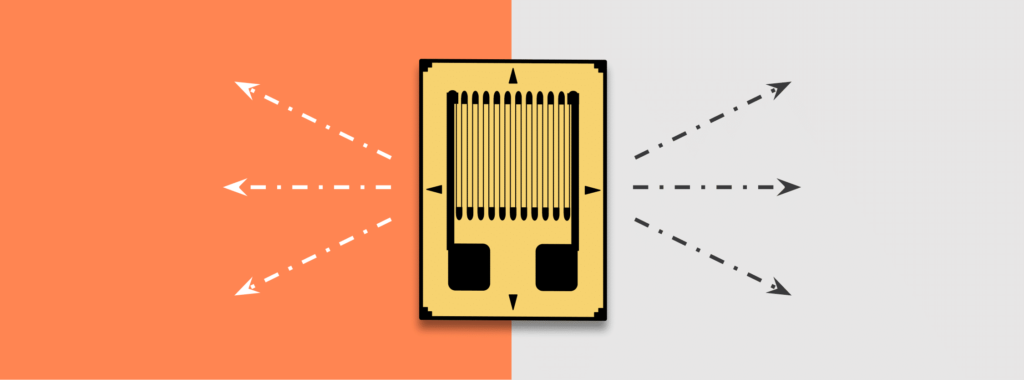
In load measurement applications, strain gauge load cells are the industry standard. They are cost-effective, highly accurate, and mechanically adaptable to many physical configurations. In this article, we take a deeper dive into their internal circuitry, the Wheatstone Bridge. We also explain how the bond between these gauges and the load cell “spring element”, or metal body, creates the predictable relationship between the force applied to the load cell and the device’s output.
Key Takeaways
- Measurement Principle: Strain gauge load cells convert mechanical force into measurable electrical signals by detecting resistance changes in tiny, bonded foil grid devices called strain gauges. An excitation voltage passing through this change in resistance creates an output signal that a readout converts to a measurement.
- The Elastic Element’s Role: The strain gauge is precisely bonded to the load cell elastic element, or metal structural body. Together, they deform under loading to stretch or compress the strain gauge. When the conductive foil stretches, its cross-section decreases and resistance increases; compression causes the opposite outcome.
- The Wheatstone Bridge as Internal Circuitry: Bridge circuits allow tiny resistance changes to be perceptible by comparing voltage drops across the bridge arms rather than comparing output voltage to the input excitation voltage, which is orders of magnitude larger.
- Accuracy as a Function of Strain: A strain gauge load cell is accurate only within the linear portion of the ratio of fractional change in resistance to its strain when loaded. This ratio of ratios is known as the Gauge Factor. Beyond this limit, load cells will be permanently damaged.
- The Industry Standard: Because of their many options of elastic element geometries and materials, high durability and accuracy, and a wide range of load capabilities, strain gauge load cells are widely used across many industries.
What is a Strain Gauge Load Cell?
As we described in our article, An Overview of Load Cells, all load cells exploit a physical property of their components to generate a human-usable measurement. A strain gauge load cell exploits the change in resistance of a wire deformed by a load to produce a measurable change in its electrical output. It has two main components:
- A spring element, or elastic element, which is a precisely machined metal body in a shape designed to fit precisely in a frame or structure to capture loads in a specific direction within that frame or structure,
and - A Wheatstone Bridge circuit containing one or more strain gauges.
Within the load cell, the strain gauge is very precisely bonded to the spring element. When this element bears the load, the strain gauges in the Wheatstone Bridge deform with it. As the next sections will show, this deformation creates a detectable change in resistance. This, in turn, alters the output signal from its zero-load reference point.
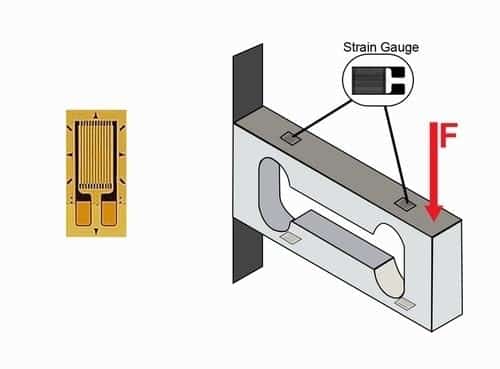
Importantly, this load cell is a passive transducer, meaning it requires an input signal, or excitation voltage, to work.
What Shapes Do Load Cell Structural Elements Have, and Why?
Strain gauge load cell elastic element shapes can be beams, s-beams, or disk-like, to name a few. In fact, strain gauge load cells are categorized and sold according to the shapes of these elastic elements. These shapes determine how the load passes through them and what structures they can fit, thus determining their uses. See Choosing the Right Load Cell For Your Job for an in-depth description of load cell shapes and their applications.
Does the Position of the Strain Gauge Within the Load Cell?
For accurate readings, the strain gauge(s) must be precisely at the point(s) where the spring element experiences the most strain when it bears a load. The gauge orientation is typically such that its long length lies along the principal axis of the measured force. The applied force must be completely axial to this intended force direction for a correct reading.
As the Wheatstone Bridge section below explains further, additional gauges can be added along different axes to eliminate unwanted forces (such as those caused by thermal expansion) or measure other forces, such as torsion.
What is a Strain Gauge?
A strain gauge is an electrical component whose resistance changes when it experiences mechanical strain from an applied force. Again, this class of load cell exploits this property to generate a signal proportional to the force causing the strain.
How Is a Strain Gauge Made?
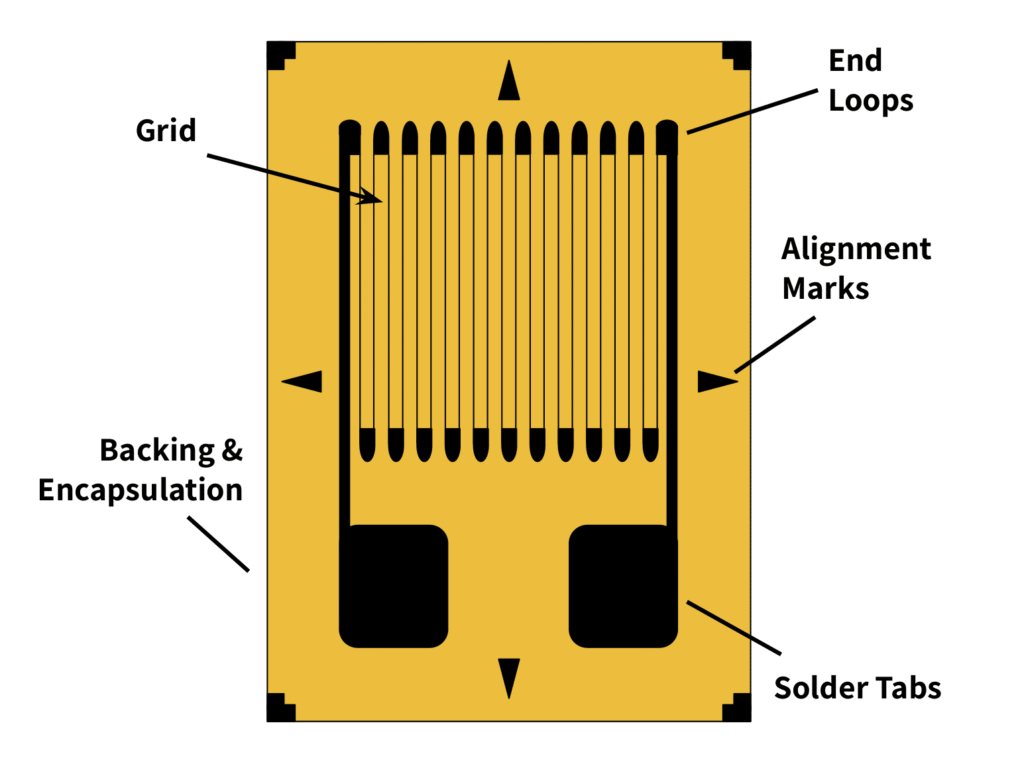
A strain gauge consists of a thin conductive foil etched in a serpentine pattern onto a non-conductive substrate. (See Figure 2.) This geometry significantly lengthens the conductor while remaining in a compact footprint. Note from the figure that the end loops are wider. This design negates the resistance difference between the conductor’s looped sections and its straight runs. Additionally, alignment marks (arrowheads) indicate the orientation for measuring orthogonal strain on the sides and axial strain at the top and bottom.
The non-conductive substrate, called a “carrier matrix” or “carrier“, serves an important purpose as well. It allows the gauge wire to flex with its conjoined spring element under load, while maintaining electrical insulation between these two metal components.
How Does a Strain Gauge Work?
In a circuit, the wire acts as a resistor, with its resistance a function of the wire’s elastic properties. When the wire stretches, its length increases, its cross-section decreases, and therefore its resistance goes up. When the wire is compressed, the opposite occurs. An analogy of this is flexible tubing. When stretched, it lengthens and narrows in cross-section, which restricts the fluid flow compared to the original tube.
The ratio of the wire’s change in length divided by the wire’s original length is known as its mechanical strain. It is expressed as the equation:
\(\epsilon = \frac{\Delta{L}}{L}\)
where \(\epsilon\) is the conventional symbol for strain, \(\Delta{L}\) is the change in length of the wire and \(L\) is the original length of the wire.
The relationship between the change in resistance of the strain gauge and the strain in the etched wire due to an applied load is approximately linear within the elastic limit of the wire. It is expressed as a ratio known as the gauge factor (\(G\)). That is:
\(G=\frac{ \frac{\Delta{R}}{R}}{ \frac{\Delta{L}}{L}}\)
or
\(G=\frac{ \frac{\Delta{R}}{R}}{ \epsilon}\)
This linear relationship is the key to the strain gauge’s operation.
How do Gauge Factor and Elastic Limit Translate to Load Cell Ratings?
Strain gauges only produce accurate measurements when the gauge factor ratio applies—that is, within the range of forces where the ratio above is linear or constant. For this reason, all load cells have rated capacities and overload limits. Most manufacturers keep the rated capacity at a weight well below the one that would cause the strain gauge to reach its elastic limit (usually 20-25% of this weight). This gives ample room for shock loads and other accidental overload situations from reaching the breaking overload limit. At breaking overload, the strain crosses the elastic limit of either the gauge, the spring element or both. This, in turn, causes a permanent deformation in the metal. When this happens, the load cell’s zero load resistance permanently changes, and it can no longer be calibrated to produce an accurate result.
The elastic limit for most metals is remarkably small. For example, the elastic limit of many high-strength steels occurs at a strain of approximately 0.001 mm/mm (or 1,000 microstrain).
Strain Gauge Load Cell Circuitry
The gauge factor tells us the resistance change in a metal is proportional to the strain. For most metals, the gauge factor is around the order of 2. This means for a strain gauge of 100 ohms unloaded, assuming the strain at the elastic limit is 0.001, the maximum change in resistance possible within the elastic limit is about 0.2 ohms.
Obviously this resistance change is very small. In fact, if a simple ohm-meter were to measure it, the change in resistance in the strain gauge would be so small that it would fall within the percent error of the meter, and therefore would be imperceptible. To accurately measure this resistance change, a strain gauge load cell employs a simple circuit known as a Wheatstone Bridge.
What Is a Wheatstone Bridge?
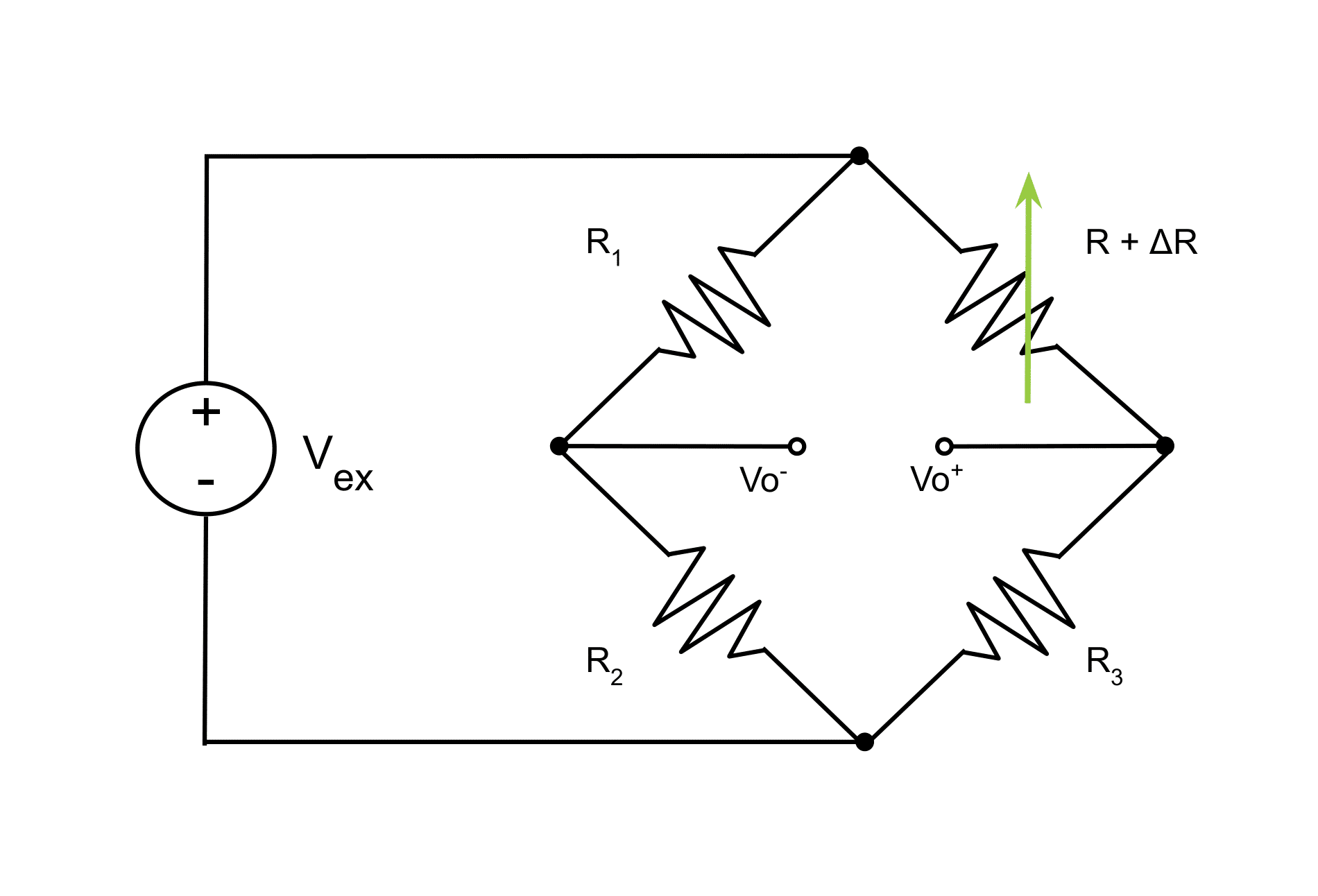
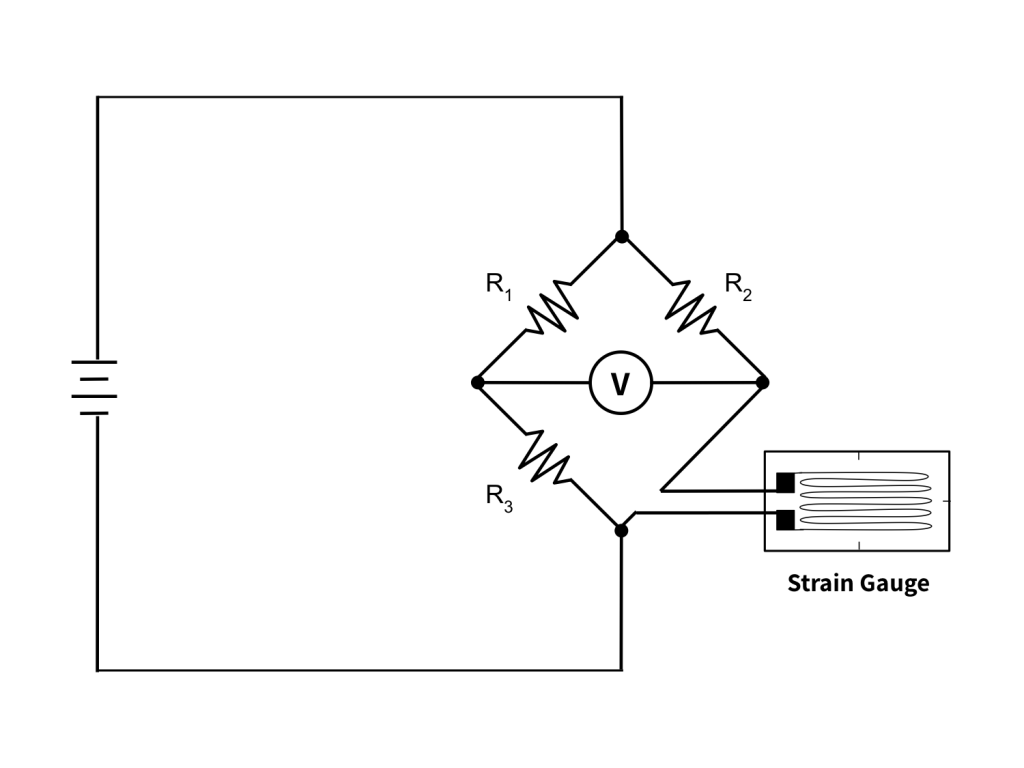
A Wheatstone bridge is simply two voltage dividers wired in parallel arms of a circuit with a common voltage source. Figure 3 shows a representation of this circuit.
The Input Voltage and Zero Load
The input voltage, \(V_{ex}\), is the excitation voltage. The variable resistor at \(R + \Delta{R}\) represents the strain gauge. \(R\), \(R_1\), \(R_2\), and \(R_3\) have equal resistances and \(\Delta{R}\) has a value of zero under no load. Therefore when the strain gauge bears no load, the voltages at the nodes \(V_{o-}\) and \(V_{o+}\) are equivalent. This means the output of the bridge circuit, which is the voltage difference across these two nodes, is zero volts.
The Output Voltage When the Gauge Experiences a Load
What happens when an applied force or load makes \(\Delta{R}\) non-zero? Let’s look at the general equation for the voltage at each output node. Recall ohm’s law states that the voltage between two nodes in a series circuit is equal to the current through it multiplied by the total resistance in that path, or more commonly seen as \(V=IR\). Rearranging, \(I = \frac{V}{R}\), the current on the left half of the bridge circuit in Figure 2 is then equal to \(\frac{V_{ex}}{(R_1 + R_2)}\). The two resistors along this path divide the excitation voltage at \(V_{o-}\). Substituting our expression for current in the left path for \(I\) in the ohm’s law equation, this voltage at the \(V_{o-}\) node is: $$ V_{o-} = V_{ex}\frac{R_2}{R_1 + R_2} $$
Similarly, the voltage at the \(V_{o+}\) node is: $$V_{o+} = V_{ex}\frac{R + \Delta{R}}{R + \Delta{R} + R_3} $$
The total output voltage is simply the difference between these two: $$ V_o = V_{o+} – V_{o-}$$ $$ V_o = V_{ex}\frac{(R + \Delta{R})}{(R + \Delta{R}) + R_3} – V_{ex}\frac {R_2}{R_1 + R_2}$$ $$V_o = V_{ex}\frac{(R + \Delta{R})R_1 – R_2R_3}{(R + \Delta{R} + R_3)(R_1 + R_2)} $$
Why Have a Bridge Circuit?
The reason the bridge circuit improves accuracy is that it essentially compares the voltage drop across the strain gauge to the voltage drop across a similar resistance for the same excitation voltage, instead of comparing it to the much larger excitation voltage itself. That means the change in voltage across the strain gauge will be the same order of magnitude as the comparison voltage. Any error in the output voltage will be a fraction of this. Also, any changes in strain due to temperature or other environmental factors will affect all of the resistors in the circuit equally. This becomes important in mitigating the effect of these environmental factors on the output.
It is important to note that, from the equations, it would seem that the larger the \(V_{ex}\), the larger the output signal; this may seem advantageous for displays or to produce a higher signal-to-noise ratio. However, there are limits to excitation voltages for signal quality. See “Does Load Cell Excitation Voltage Matter” in our FAQ.
The Quarter, Half, and Full-Bridge Configurations
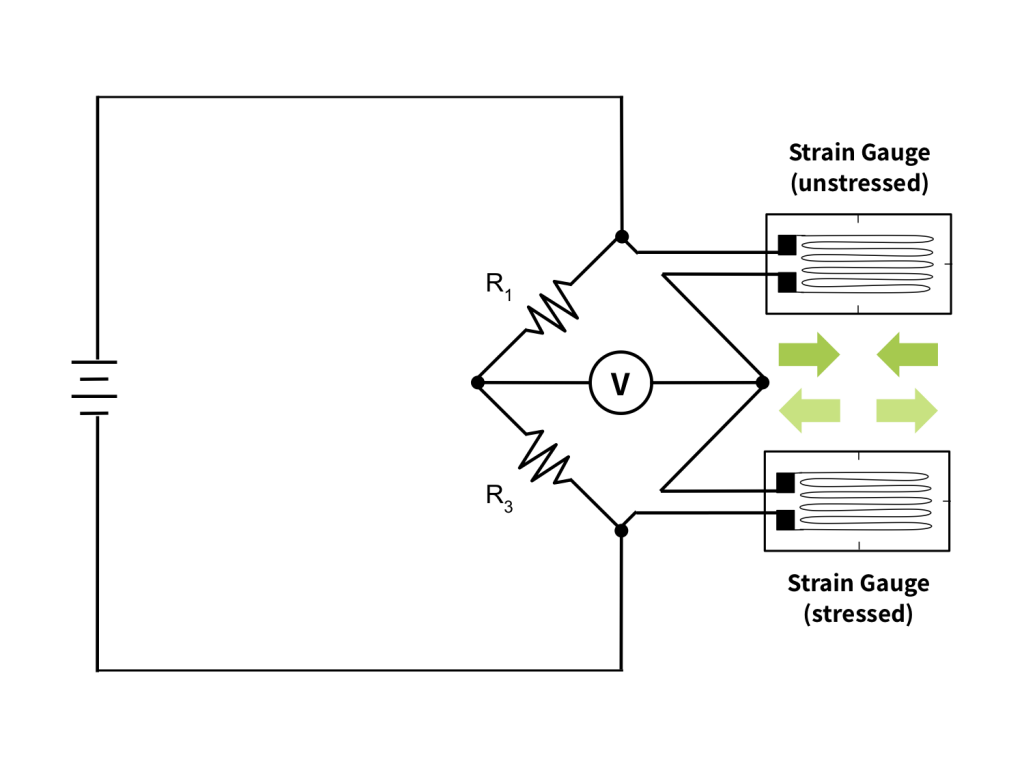
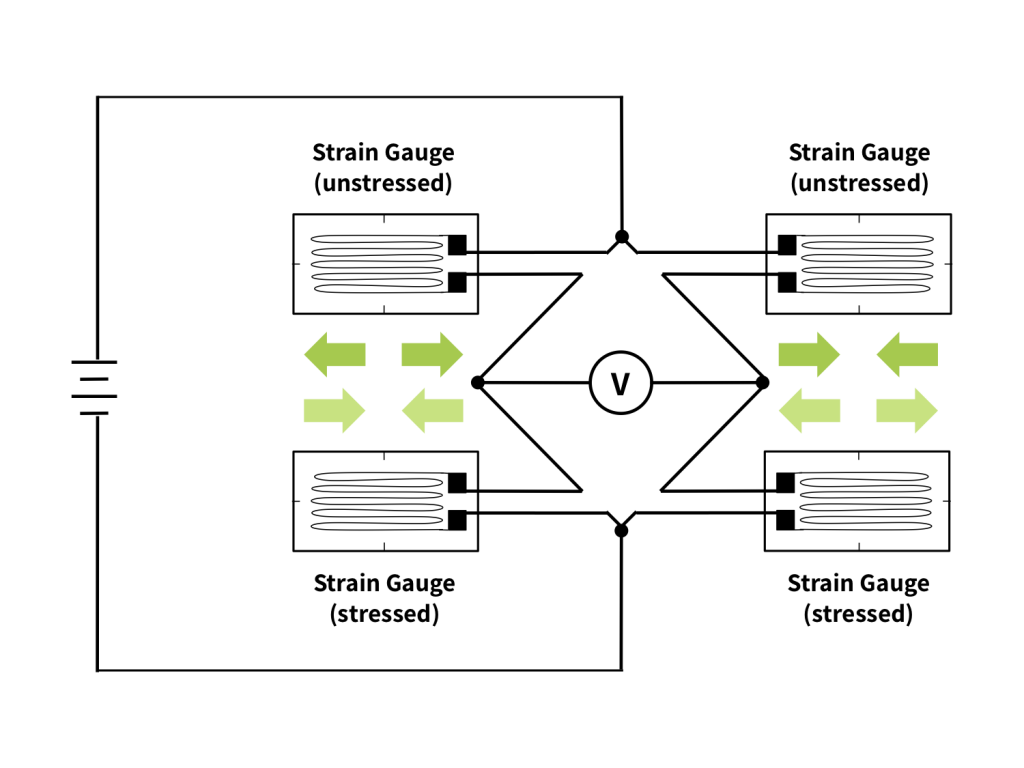
All Wheatstone bridges have four resistive elements. However, in load cell design, the number of those elements that are strain gauges vs non-variable resistors is flexible. If only one of the resistive elements in the bridge is a strain gauge, it is a quarter bridge. If two are strain gauges, it is a half bridge. And in the case where all four resistive elements are strain gauges, the Wheatstone bridge is a full bridge. See Figures 4-6 below.
How Does the Bridge Configuration Affect Load Measurement?
The pros and cons of each bridge configuration motivate the choice for a particular application. In general, fewer gauges mean cheaper construction and easier installation. However, additional gauges increase bridge output, allow for temperature compensation, and cancel unwanted strain components.
Cancelling Unwanted Strain Components
To understand how bridge configurations cancel unwanted strain, it is important to know this property of the Wheatstone Bridge:
Strains on adjacent positions in the bridge cancel, while strains on opposite bridge arms sum.
Now, let’s assume that we want to cancel a bending strain in a loaded beam and just measure tensile strain. To accomplish this, the structural element contains a strain gauge at both the top and the bottom (vertically aligned). The circuitry in the load cell is a half-bridge configuration with the gauges on opposite bridge arms. In this case, the strain measured at the top gauge will include the load strain plus tensile strain due to bending. The bottom gauge will have a compressive bending component of similar magnitude but opposite (or negative) relative to the tensile component at the top. Since the strains on opposite bridge arms sum, the bridge output voltage will reflect only the load strain components, since the equal and opposite bending strains will cancel.
Cancelling Unwanted Temperature Components and Measuring Non-Axial Forces
Likewise, strain components due to temperature add equally to all gauges in a bridge configuration. Therefore, by placing a non-loaded gauge in a position adjacent to a load-bearing one, the strain components due to temperature will cancel.
In addition, bonding gauges at angles to each other on the spring element can account for additional (non-axial) strain components and determine the angle of maximum strain. This configuration of strain gauges is called a strain gauge rosette.
Conclusions
The strain gauge load cell remains the industry standard due to its unique combination of mechanical adaptability and electrical precision. For this reason, it is the main offering in Tacuna Systems’ product line. By leveraging the predictable relationship between physical strain and electrical resistance, strain gauge load cells have many advantages over other sensors, including:
- Low cost,
- High accuracy (especially due to the wide variety of bridge configurations and bonding geometries),
- Durability,
- Versatility and practicality for many applications (because they can fit into a wide array of supporting structures and can handle a broad range of loads).
Ultimately, a load cell’s performance is affected not just by the strain gauge itself, but also by the integrity of the bond to the spring element and the sophistication of the bridge circuit used to isolate the signal. Understanding these internal design elements leads to a higher quality sensor selection and more effective troubleshooting in the field.
Further Reading
For more information, we suggest the following articles:
- Choosing the Right Load Cell For Your Job describes the different strain gauge load cell types offered by Tacuna Systems, and their uses.
- How Can I Tell If a Load cell Is a Quality One? answers this important question.
- How to Test for Faults in Load Cells gives important troubleshooting tips.
- Why Do I Need a Load Cell Amplifier (and Other Signal Conditioners)? and Load Cell Summing: Junction Boxes, Signal Trim, and Excitation Trim: give further information on load cell signaling.
- Load Cell Mounting and Installation Best Practices, to ensure that measuring accuracy is not affected by improper installation.