

All electronic force measuring systems, including industrial weighing systems, consist of a series of components. These components carry the end-to-end signal flow, from the force sensor(s) to the output display or control system. Each of these inevitably introduces error into the final measurement. As the components wear with age, this vulnerability only increases.
Calibration is the process of comparing a system’s actual output signal or weight indication to a known standard and adjusting the system so that it outputs the correct value within an acceptable tolerance. This known standard is simply a very precisely machined test weight, or a machine that applies a settable force, that is directly traceable to an authoritative primary standard. This article explains the end-to-end process of calibrating a force measurement system to ensure absolute accuracy throughout its operational service life.
Key Takeaways
- Component-Level Vulnerability: Every element in a force-measuring chain, from the load cell to the signal conditioner and output device, can introduce measurement drift.
- Systematic vs. Random Errors: Calibration directly targets and minimizes systematic errors (like zero and span shifts), while understanding the baseline statistical boundaries of random errors.
- The Calibration Sequence: Calibration involves an iterative sequence: first adjusting a scale’s zero-load baseline, next setting the full-scale span, and finally running stepwise, multi-point loading cycles to verify system linearity and repeatability.
- Strict Calibration Protocols: Maintaining a system’s accuracy requires controlling ambient conditions, utilizing precise force standard machines, and employing qualified technical personnel.
- Routine Maintenance Schedules: Force measuring systems should undergo field calibration at least once every two years, or more frequently when operating under harsh environmental conditions.
Architecture of an Electronic Force Measuring System
NOTE: For consistency with International Standards, we refer to the measured quantity as the measurand in this guide. It can refer to any one of the following: load, weight, force, and pressure.
A deployed force measurement system is always the sum of its parts. While routine maintenance calibrations are typically performed on the entire end-to-end apparatus (loop calibration), individual components matter. If a system fails to calibrate within expected tolerances, technicians must isolate and evaluate each component to locate the source of the error.
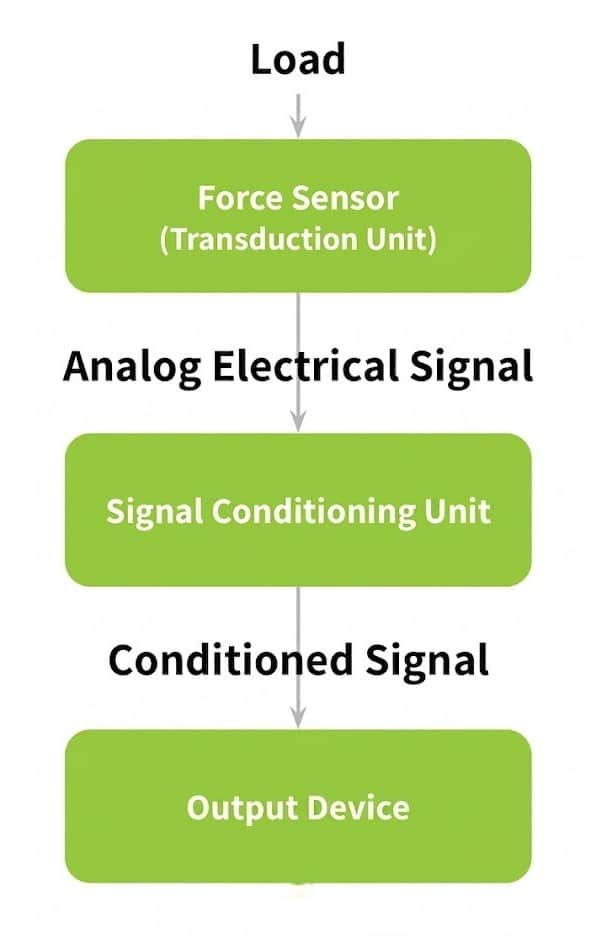
An electronic force measuring system typically relies on three core stages: Input Transducers, Signal Conditioners, and Output Devices.
1. Input Transducers (Load Cells)
Weigh systems collect input from a single load cell or multiple load cells wired into a single summing box. These transducers convert the applied mechanical force into a proportional electrical signal.
2. Signal Conditioners
Because a raw load cell output signal is incredibly small (measured on the order of millivolts), it is highly susceptible to interference. Signal conditioners filter out electrical noise, isolate circuits, and amplify the signal to a usable voltage or current.
3. Output Devices
Depending on the application, the conditioned signal is routed to one or more of the following destinations:
- Monitoring Systems: Visual instruments that convert the electronic signal into a human-readable format, such as a digital LCD weight display.
- Data Storage Devices: Systems that digitize and record measurement signals into a database for future tracking and historical analysis.
- Control Systems: Automated processing units that deliver the measurement data to an industrial feedback loop to manage live processes, such as automated batch dispensing or flow control.
How the System Architecture Influences Calibration
Our article, Measurement Uncertainty in Force Measurement, explains the potential errors and theoretical uncertainties inherent in each of these components. Isolating those factors is crucial when a system calibration yields outlier results. However, this guide focuses on calibrating the measuring system as an integrated whole, as loop verification is fundamental to maintaining a deployed field system. By regularly adjusting its output to the expected value within an acceptable tolerance, the system can provide years of accurate, reliable service.
It is important to note that operational calibration tolerances are rarely based solely on the manufacturer’s factory-specified values. Instead, an acceptable tolerance window depends heavily on the specific requirements of the industrial process and the capabilities of the available test equipment.
Systematic vs. Random Errors in Deployed Scales
The definition of error is the difference between the measuring system’s output reading and the true value of the measurand. Measurement errors fall into two distinct operational categories: systematic errors and random errors.
Systematic (or Deterministic) Errors
Systematic errors predictably occur during the normal use of measuring devices. The material properties of the internal load cells and system construction largely contribute to these inherent, repeatable errors. Regular calibration and proper measuring system technique can mitigate them considerably.
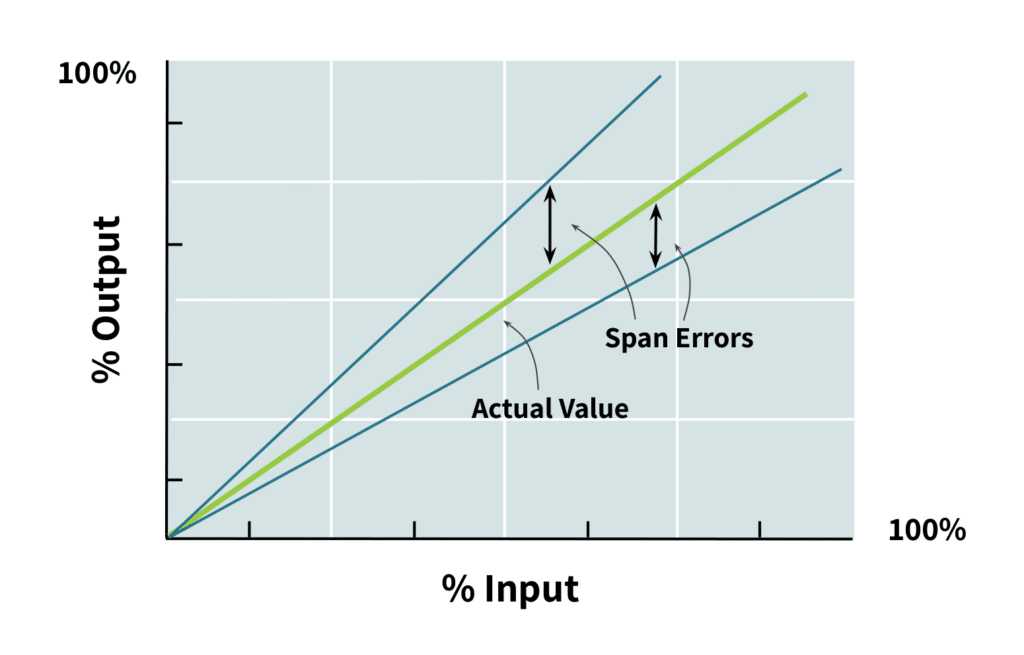
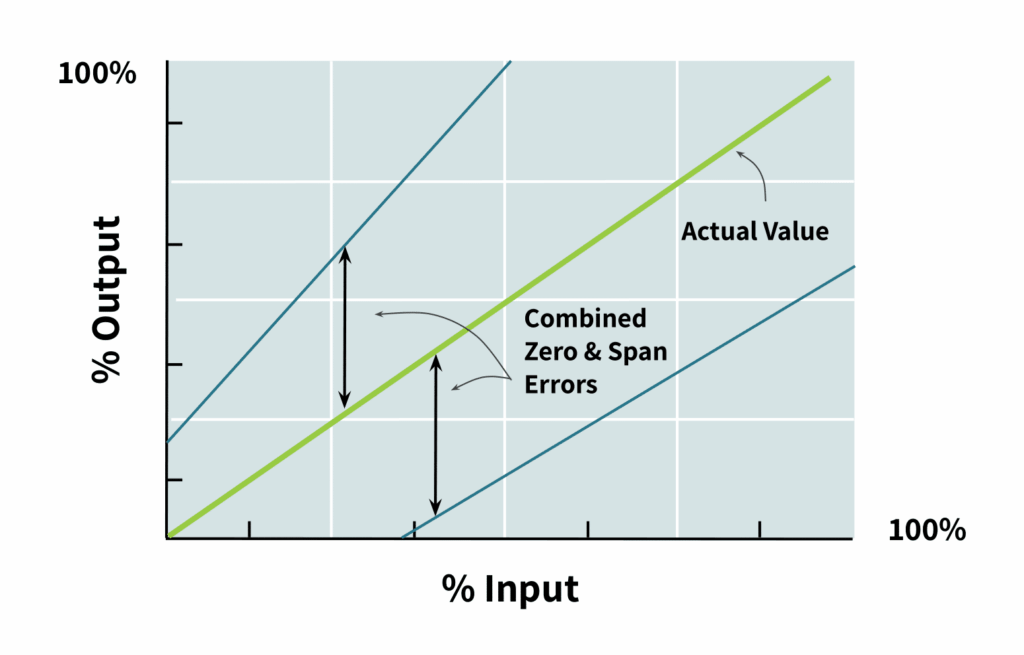
The two main types of systematic errors are zero errors and span errors. These combine to produce a compound systematic error (illustrated in Figure 3) that widens over time.
Zero Errors
Zero errors occur when the system displays a non-zero output despite being completely unloaded. A zero error shifts the entire input-output calibration curve parallel to the true value line, acting as a constant additive error across all weight points. (See Figure 1.)

Span Errors
Span errors alter the slope of the input-output curve. A span error means the measurement discrepancy widens proportionally as more force is applied to the system. (See Figure 2.)
Random (or Stochastic) Errors
Random errors are unpredictable, statistical variations that cause positive and negative fluctuations around a mean measurement value. These variations stem from the precision limitations of the electronics and erratic external environmental shifts, such as transient electrical noise, minor thermal spikes, or ambient building vibrations.
Because random errors are unpredictable, calibration cannot adjust for them. Instead, they are quantified using statistical methods such as calculating standard deviations across repeated test measurements and factored into the total system error.
As the document Measurement Uncertainty in Force Measurement explains, the total system error is then expressed as a mean value plus or minus a stated number of standard deviations within a confidence interval of a given percentage (usually two standard deviations with a 95% or three standard deviations with a 99% confidence interval).
Real-World Sources of Measurement Drift
Whereas calibration can adjust for systematic errors, a proper understanding of their sources can mitigate their presence in the first place. These sources generally fall into two categories: external operational variables and inherent sensor behaviors.
External Operational Variables
- Inconsistent Measurement Methods: If a technician applies a load unevenly, places a weight off-center, or alters the rate of force application between tests, it introduces non-axial loads that distort electrical readings.
- Instrument Calibration Drift: Over extended use, electronic components naturally age, and components like amplifiers and strain gauges slowly drift from their original factory settings.
- Mechanical Lag: Load cells naturally behave like stiff springs; they briefly oscillate under initial loading. Reading a measurement before the sensor has fully reached its steady state results in an artificial error.
Inherent Sensor Behaviors
- Hysteresis: This is a property of the load cell’s elastic element material. The sensor retains a minor mechanical “memory” of applied forces, meaning the voltage output will vary slightly at the same weight point depending on whether the load was reached via increasing force or decreasing force.
Environmental & Technical Requirements for Accurate Calibration
The International Society of Automation (ISA) defines calibration as “a test during which known values of a measurand are applied to the transducer and corresponding output readings are documented under specified conditions.” Variations in these four specific conditions outlined by the ISA will introduce stochastic errors that corrupt the calibration test itself.
1. Ambient Conditions
A load cell data sheet lists predicted errors based on tests done under specific ambient conditions. If a measuring system operates in an environment that deviates significantly from the manufacturer’s factory laboratory baselines of the following, it will require specialized compensating electronics or precise field recalibration to ensure accuracy.
- Temperature & Humidity: Thermal fluctuations physically alter the electrical resistance of a load cell’s internal circuitry, skewing the calibration curve. Shifting humidity levels can also compromise insulation resistance in unsealed components.
- Barometric Pressure & Altitude: Because altitude reduces atmospheric pressure, significant elevation differences can reduce the forces on unsealed or uncompensated sensors, altering their baseline output.
- Mechanical & Electrical Noise: Localized machinery vibrations, ambient wind currents, and transient electromagnetic interference (EMI) insert parasitic random noise into millivolt-level sensor output signals.
2. The Force Standard Machine
The force standard machine is the reference apparatus used to verify the testing instruments. To ensure valid mathematical boundaries, this reference equipment must meet strict accuracy and traceability standards:
- The Accuracy Ratio (TUR): To prevent the reference machine from introducing its own excessive uncertainty, its measurement error should be strictly controlled. While a 3:1 ratio (where the machine is three times more accurate than the scale) is sometimes used as a bare minimum field threshold, industry best practice dictates a 4:1 Test Uncertainty Ratio (TUR).
- Metrological Traceability: The reference machine’s accuracy must be verified periodically using a higher-tier standard. This sequence forms an unbroken chain of comparison that must ultimately be traceable to International System of Units (SI) baselines via accredited calibration laboratories and National Metrology Institutes (NMIs) such as NIST in the United States.
3. Technical Personnel Qualifications
Calibration is highly sensitive to operator error. Field personnel must be qualified system technicians who possess a cross-disciplinary understanding of both mechanical and electronic instrumentation. Specifically, technicians must be trained in:
- Dynamic Control Theory: Understanding how systems respond to live, moving force inputs.
- Analog and Digital Electronics: Managing weak millivolt signals, grounding loops, digital data conversion, and microprocessors.
- Pneumatic, Hydraulic, and Mechanical Systems: Safely executing physical load applications and structural alignments.
- Field Instrumentation: Complete familiarity with field calibration equipment.
4. Operating Procedures for Calibration
Beyond technical knowledge, calibration requires meticulous procedural discipline to satisfy quality management standards like ISO 9000. Technicians must follow a formalized, documented sequence and log every variable in real time. Every calibration record must clearly capture:
- Traceable Device Identifiers: Complete asset information, including the system or load cell serial numbers.
- The Calibration Parameters: The exact weight range tested, specific measurement intervals, and the operational mode used (tension or compression).
- Environmental Metadata: The exact date, time, and ambient environmental conditions present during the test loop.
If an organization lacks the specialized reference equipment or certified personnel required to maintain these strict operating procedures, it should seek professional, manufacturer-backed load cell calibration services.
Weighing Standards and Metrological Traceability
In metrology, the term “standards” refers to two separate but related concepts. The first is the documentation that sets forth measuring instrument performance tolerances within a trade jurisdiction (see Load Cell Classes: NIST Requirements, and Load Cell Classes: OIML Requirements).
The other “standards” are undisputed benchmark values of the units of measure (such as precision test weights) against which system accuracy is determined. Every calibration must establish a link through an unbroken chain of comparisons from the test measurand to the highest, universally recognized physical value of that unit. (Standards bodies like OIML warehouse these highest units in highly controlled environments.)
This standards hierarchy has four tiers:
1. Primary Standards
Primary standards represent the highest echelon of metrological accuracy. Again, they are maintained exclusively by National Metrology Institutes (NMIs), such as NIST in the United States or the International Bureau of Weights and Measures in France. These institutions use ultra-precise primary deadweight machines to manufacture and maintain national force standards with the absolute lowest possible measurement uncertainty.
2. Secondary Standard
A secondary force standard is an instrument or mechanism whose calibration has been established by comparison with the primary force standard. Maintained by accredited calibration laboratories, they serve as the legal calibration vector for industrial equipment.
Working Force Standard
Working force standards are the instruments that verify the accuracy of testing machines. Their calibration may be by comparison with primary force standards or secondary force standards. They are also called the force standard machines.
Traceability
Traceability refers to the chain of comparison of a standard to another more accurate standard, which has been compared to another more accurate standard, and so forth. The most accurate standard in this chain must be established by the authoritative standards body that maintains that standard of weight or measurement. At each level, the test standard should be about 4 times more accurate than the system using it for calibration.
Calibration Methods
There are four primary methods of calibrating a force measuring system: 1) zero and span calibration; 2) individual and loop calibration; 3) formal calibration; and 4) field calibration.
Zero and Span Calibration
Zero and span calibration eliminate the zero and span errors of the instrument. Most measuring systems have adjustment knobs or similar for these purposes. Zero adjustments reduce the parallel shift of the input-output curve shown in Figure 1. Meanwhile, span adjustments change the slope of the input-output curve shown in Figure 2. Tacuna Systems’ instruments allow for both zero and span adjustments (see this manual).
Individual Instrument and Loop Calibration
Individual instrument calibration is as the name suggests. It calibrates each component in the measuring system in isolation. Each component is first decoupled from the measuring system. Then, a known, standard source provides a range of inputs at known intervals to the component; the output is measured for each input with a calibrated readout or data collection device. Again, the technician must record each input and output meticulously.
Loop calibration, on the other hand, tests the measuring system as a whole. A known, standard force is applied to the loading platform of the entire system. The technician then records the output displayed on the system’s readout. This has the advantage of verifying the whole system all at once which saves time. If the system is able to meet the required tolerances through adjustments during the process, this type of calibration is sufficient.
Formal Calibration
Formal calibration refers to calibration procedures in an approved laboratory. This type of calibration is necessary for instruments whose use requires certification by a standards body, traceable to primary standards, for official measurements. This type of calibration requires highly controlled temperature, atmospheric pressure and humidity.
Formal calibration of the system entails calibration of each component: the transducers, displays, measuring, analyzing and computing instruments.
Field Calibration
Field calibration is a field maintenance operation at the installation site of the measuring system. This ensures there is no deviation from the normal operation, and outputs are still within maintenance tolerances. (See Load Cell Classes: NIST Requirements for a more detailed description of maintenance tolerances.) Field calibration determines the repeatability of the measurements and not the absolute accuracy of the measurement.
Note that any alterations to load cell cables could affect field calibrations and conformance to tolerances on the load cell data sheet. See our FAQ for further details.
A Step-by-Step Calibration Procedure for Force Sensors
Different approaches exist for calibrating a force measuring system; however most generally follow the steps below, in a stable, controlled environment to the extent possible.
- Set the input signal to 0%, that is zero or no-load. Then adjust the initial scale of the measuring system to reflect no load.
- Next, set the input signal to 100%, or the full-scale output capacity. Then adjust the full scale of the measuring system.
- Reset the input signal back to 0% and check the system’s output readings. If the value is more than one-quarter of the rated value on the instrument’s datasheet, readjust the scale until it falls within the tolerance level. This is also called the zero adjustment.
- Reset the input signal to 100% and check the instrument’s output reading. If the value is more than one-quarter of the rated value on the instrument’s datasheet, then readjust the scale till it falls within a tolerable range.
- Repeat steps 3 and 4 until the zero-balance and the full scale are within the tolerance of one-quarter of their nominal values. This is the span adjustment.
- The calibration procedure should define the calibration range (the maximum and minimum weights in the calibration), and the measurement intervals in the measuring cycle. If the cycle has 5 intervals, apply loads sequentially as 0%, 20%, 40%, 60%, 80%, 100%, 80%, 60%, 40%, 20%, 0% of the calibration range. If it has 4 intervals, apply loads of 0%, 25%, 50%, 75%, 100%, 75%, 50%, 25%, 0%. To avoid lag errors, record the observed readings after a sufficient period of stabilization. Note the calibration range may differ from the instrument range, the latter referring to the capability of the instrument (often greater than the desired measurement range or calibration range).
- Repeat step 6 to determine the repeatability of the measurements.
How Often Should a Force Measuring System Be Calibrated?
A force measuring system must be calibrated before its initial field installation. Once a system is actively deployed, operational environments dictate the ongoing maintenance schedule. Calibration every two years is the maximum interval recommended for stable, light-duty applications. Industry best practice typically requires annual recalibration.
Acceleration of this schedule is necessary if the weighing system meets any of the following criteria:
- “Legal for Trade” Requirements: Systems certified for commercial trade must adhere to strict regulatory verification intervals.
- Harsh Environments: Exposure to chronic mechanical shock, corrosive chemicals, washdown moisture, or extreme thermal cycling accelerates component degradation.
- High-Frequency Usage: Systems experiencing continuous or high-cycle loading patterns encounter faster structural and electrical fatigue.
- Data-Driven Drift Trends: Comparing historical calibration certificates from year to year can reveal baseline drift, signaling the need to shorten the window between service intervals.
Conclusion
Routine system calibration is fundamental to reliable industrial data collection. It also forms the core of a preventative maintenance strategy that extends hardware lifespan.
The calibration process generates a detailed calibration curve that charts the precise relationship between a known input force and the system’s electrical output. This performance map quantifies essential operational parameters, including system sensitivity, linearity and hysteresis.
Ultimately, the goal of loop calibration is to ensure that the sensor, cabling, summing box, and instrumentation work in perfect harmony to deliver reliable measurements within acceptable tolerances. If a system fails to calibrate within these required tolerance windows, begin isolating the hardware by following the procedural steps in How to Test for Faults in Load Cells.
Finally, Tacuna Systems offers professional calibration services that can be added to a scale or load cell purchase to ensure optimal operation.
References
- The Calibration Principles.
- The Calibration Handbook of Measuring Instruments by Alessandro Brunelli.
- The Instrumentation Reference Book by Walt Boyes.
- A Guide to the Measurement of Force by Andy Hunt.
- The Standard Practices for Calibration and Verification for Force-Measuring Instruments.
- Force Measurement Services at NIST: Equipment, Procedures, and Uncertainty
- Force Measurement Glossary
- MechTeacher – Generalized Measurement System